Thule ReVert Vertical Bike Rack Review
Vertical bike racks have been game changers for years, and the Thule ReVert takes this concept to the next level. As the first vertical bike rack to offer lift assist both up and down, the ReVert addresses a major pain point of vertical racks: lifting a fully loaded rack!
After testing and owning several different vertical bike racks over the years, I can confidently say that the Thule ReVert is my top choice for daily use. While we also love and wholeheartedly recommend the Alta and VelociRAX, the ReVert’s ease of use puts it at the top of my list.
In this review, we’ll cover why the Thule ReVert is our top choice for most riders, as well as when and why the Alta or VelociRAX might be a better fit for you.
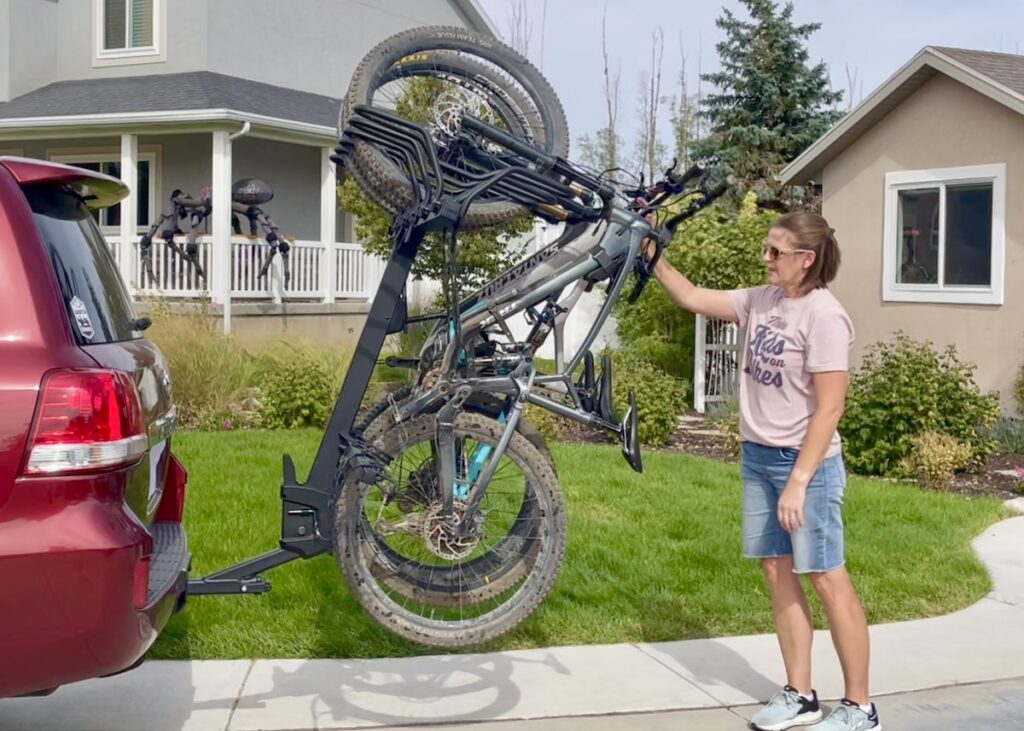
Thule ReVert Bike Rack Overview

RATING: Exceptional
MSRP: $899 (4 capacity), $1,099 (6 capacity)
BEST FOR: Anyone looking to haul more than 4 bikes sized 20″ and up
WHEEL SIZE COMPATIBILITY: Fits 26” to 29” up to 3” wide, 20” and 24” (with adaptor), Tires up to 5” wide with fat tire basket
HITCH SIZE: 2″, Class III only (minimum 500 lb. load)
AVAILABLE ADD-ONS: Fat-tire wheel basket, Integrated Bike Lock, Repair Stand Holder, 20/24” Wheel Adapter
PROS:
- Lift assist makes it super easy for one person to push up a fully loaded rack, even on high-hitch vehicles.
- With just one or two bikes loaded, the rack automatically lifts after pulling the release lever.
- The rack also assists when lowering, preventing bikes from crashing down.
- Minimal bounce and feedback while driving with a loaded rack.
- Securely locks onto the hitch with no tools needed to install or remove.
- Wide, easy-to-use wheel straps.
- Wheel cradles on the lower bar keep bikes steady during loading.
- Optional repair stand kit allows for quick maintenance at the trailhead.
CONS:
- Hard to see when empty on a parked or moving vehicle at night (we recommend adding reflective tape).
- Significant effort is required to pull down when empty (placing a foot on the rack helps a lot!).
- Only available in 4 and 6 bike capacities.
- After extended use, the rack can develop a squeak at the base (not the hitch receiver) when driving around town with an empty rack.
Thule ReVert Bike Rack Review
Who is the ReVert best for?
- Shorter individuals or those with limited upper body strength: The ReVert’s lift assist is especially helpful for people who may struggle with lifting a vertical rack (it’s the only rack with this feature).
- Families or groups with 3+ bikes: We found vertical racks to be easier to use than 4-tray platform racks.
- E-bike riders: With a weight capacity of up to 250 lbs (220 lbs for the 4-capacity model) and a 55 lb limit per bike, the ReVert makes lifting and lowering e-bikes easy.
- Anyone who frequently removes their bike rack: The Thule ReVert quickly mounts and detaches from the hitch without tools. It includes an integrated hitch pin and lock, so there’s no loose parts to lose (except the key!)
- Owners of unibody vehicles: The ReVert performs well on all vehicles but is particularly beneficial for cars with unibody frames, as it provides less feedback compared to other vertical bike racks. Our testers noted reduced bike bounce on the ReVert compared to other racks.
Who is the ReVert not the best fit for?
- Those seeking a multi-sport rack: The Alta and VelociRAX offer ski kit options.
- Users wanting a “swing out” feature: Alta has a full swing-out option, and VelociRAX offers a swivel mount (best for vans with bi-fold doors)
- Families with smaller kids’ bikes: The ReVert is best for bikes 24” and up. While the 20/24″ adaptor works with 20″ bikes, due to the way the adaptor positions 20″ bikes, hauling more than one 20″ may be problematic.
- Those with rack storage concerns: The VelociRAX comes with a wall mounting system that allows you to store you rack, and bikes, on the wall. A rolling floor mount is also available.
- Cars without a 500 lb, Class III 2″ hitch receiver.
- Road or gravel bike riders with drop handlebars: Although we haven’t tested it, the ReVert 6-capacity likely won’t fit more than three bikes with drop bars.
- Bikes with fenders or e-bikes over 55 lbs.
Thule ReVert vs. VelociRAX vs. Alta Vertical Bike Racks
With years of experience using the Alta and VelociRAX (links to our reviews), we’ve gained valuable insights into what makes the Thule ReVert unique. Below are the ReVert’s six main differentiators. Keep reading for an in-depth look at each, or click on the blue titles to jump directly to those sections in our review.
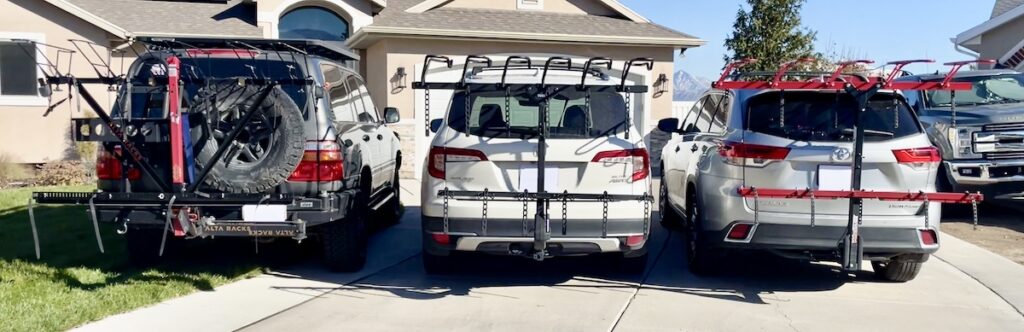
Five Unique Features of the Thule Revert
1. Lower and LIFT Damper Assist: A game-changer for vertical racks! Lift assist significantly reduces the force required to raise a loaded rack, addressing a common pain point. The Thule also slowly lowers a full-loaded rack.
2. Less Feeback: The Thule provides significantly less feedback to the driver compared to the VelociRAX or the Alta (when used without straps). You’ll hardly feel the rack while driving!
3. Tool-Free Mounting and Removal: The ReVert easily attaches and detaches from the hitch without the need for tools.
4. Integrated Hitch Lock: Comes with Thule’s locking barrel lock for secure attachment.
5. Built-in Hitch Pin: The hitch pin is integrated into the hitch arm, so you’ll never lose it!
Eight Features Shared with Other Vertical Bike Racks
1. Great Ground Clearance: The hitch arm extends upward, providing improved ground clearance—less than the Alta but more than the VelociRAX.
2. Tilts While Fully Loaded: The rack tilts to allow easy access to hatchbacks, even when fully loaded.
3. Roll-In Loading: Loading is easier than on platform racks—just stand your bike upright on its rear wheel and roll it onto the rack.
4. Generous Spacing: The ReVert offers 11” of spacing between baskets. For comparison, the VelociRAX 6 has mostly 10” spacing with one 12” gap, while Alta’s spacing is adjustable.
5. Optional Bike Repair Stand: This handy add-on (link to REI) allows for easy trailside maintenance. Alta Racks also offers a repair stand.
6. Optional 20/24” Adapter: This adapter allows the rack to hold kids’ 20” and 24” bikes without basket swaps. While it takes some effort to snap into place, the adapter doesn’t require any tools to mount. Alta and VelociRAX both need a separate basket for 20″ bikes and the VelociRAX requires tools to mount.
7. Optional Fat-Tire Basket: This basket fits fat bike tires up to 5” wide.
8. Optional Integrated Cable Lock: Secures bikes to the rack’s upper bar via an external cable.
What types of bikes are compatible with the ReVert?
The ReVert is primarily designed for all styles of mountain bikes but works well with most traditional bike styles, including hybrids. For bikes with tires 26” and up, compatibility is generally not a problem, though certain handlebar styles—like drop bars on road bikes or swept-back bars on cruisers—limits the total capacity as the handlebar bump against the frame or handlebars of a neighboring bike in the rack (this is true on the Alta and VelociRAX as well).
For bikes with fat tires between 3.1” and 5.0”, you’ll need the optional fat tire basket.
Using the Thule ReVert Bike Rack vs. Other Racks
Compared to the Alta, the main selling point of both the Thule ReVert and the VelociRAX is their built-in damper. As a result, this review will focus on comparing the Thule ReVert and VelociRAX, highlighting their major differences at each stage of use, including installation.

Before we dive in, it’s worth noting that the Thule ReVert loads in the same way as the VelociRAX and Alta—by rolling in or placing the bike’s front tire into the wheel basket. This wheel basket loading style is significantly easier to use than the handlebar-loading style of racks like the Lolo or North Shore, which we found more challenging.
Loading the Thule ReVert
1. Remove the Safety Pin
The ReVert features a user-friendly safety pin that you simply pull out before lowering the rack. Attached to the rack by a metal cable, the pin is secure and won’t get lost. It also includes a clip to keep it in place, whether inserted or not.

The ReVert’s pin is easier to remove than VelociRAX’s and, unlike the Alta’s, it’s tethered so it can’t be misplaced.
2. Lower the Bike Rack
My only real complaint with the ReVert is the effort needed to pull it down when empty. Since the damper is designed to assist in lifting a fully loaded rack, it creates resistance when lowering the empty rack, as you’re working against the damper.
To lower the rack, start by pressing down on the large black release lever. This lever extends out from the main mast, making it easy to reach and operate. Once the lever reaches the bottom of its slot, begin pulling down on the rack.
Placing one foot on the base of the rack for leverage makes the process much more manageable, allowing you to use your legs and body weight rather than relying solely on upper body strength. Though it may feel challenging at first, it becomes easier with practice as you get used to the technique.

Compared to the VelociRAX, the ReVert does require more effort to pull down, but having a place to brace your foot on the ReVert actually makes it a bit quicker and easier than the VelociRAX, which lacks a foothold and relies on upper body strength alone.
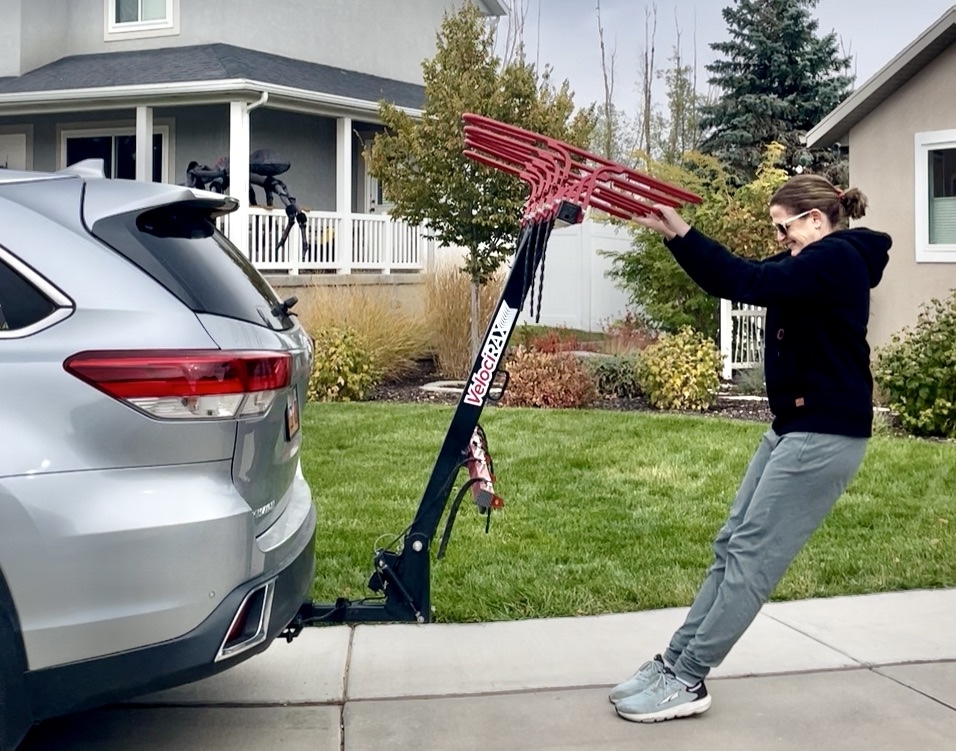
The Alta, by contrast, does not use a damper, so there’s no resistance when lowering the rack.
3. Loading Bikes
To load bikes, first raise each bike into a wheelie position, then roll the front tire into the basket. Start with the leftmost basket, loading the largest bike first, and work your way to the right with progressively smaller bikes. Using your knee to help lift the bike into the basket can be especially helpful.

As with any vertical rack, the height of your vehicle’s hitch affects loading ease: the taller the hitch, the less you’ll be able to “roll” the bike in, requiring more of a knee boost to lift the bike into place.
In the images below, I’m loading the same XXL bike onto two different vehicles: a full-size SUV with a 25” hitch height on the left and a mid-size SUV with a 19” hitch height on the right. Notice the added lift needed for the taller vehicle. Shorter bikes (essentially any bike shorter than this XXL bike! 😄) will need even more boosting, as the front tire may not reach the wheel basket lip.
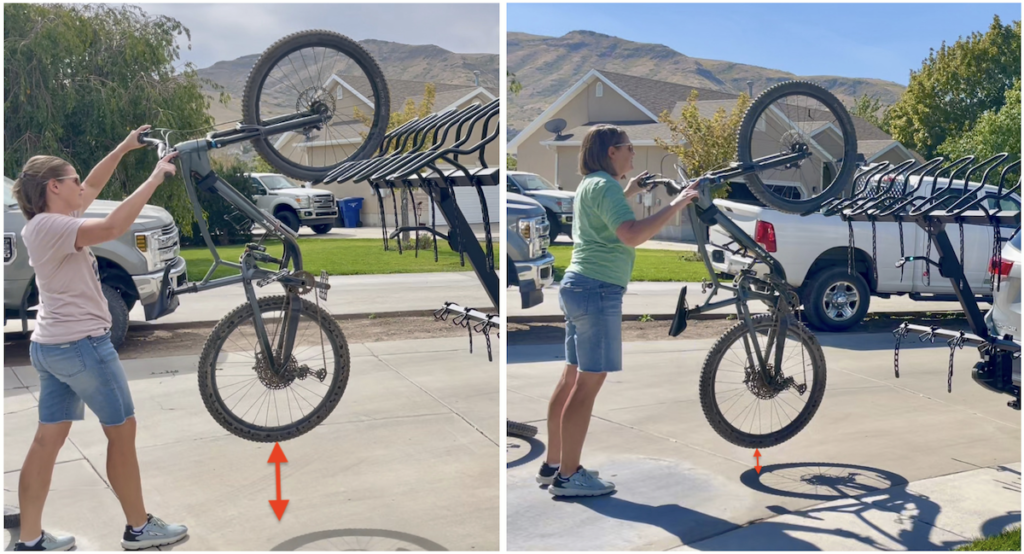
I’m 5’10”, so I find loading bikes manageable, but shorter users might have a tougher time, especially on vehicles with a high hitch. Bikes with shorter wheelbases do need a bit of extra lifting and often require more effort to get into place.
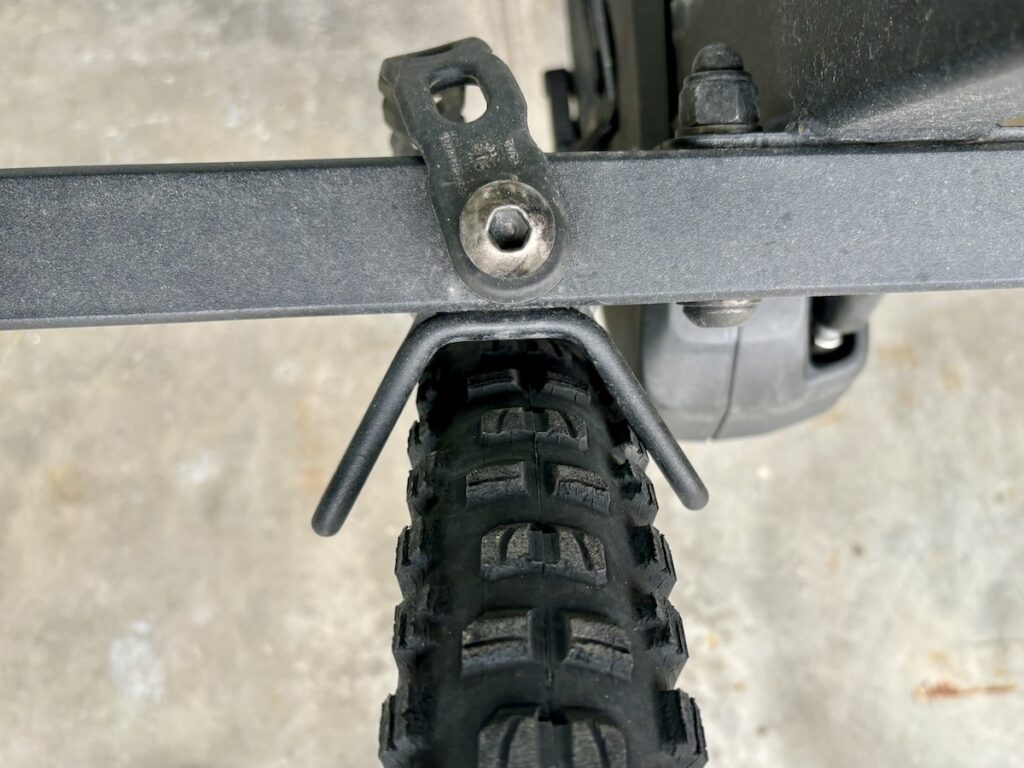
One unique feature of the ReVert is its wheel cradles along the bottom bar. These cradles help minimize bike swaying during loading, reducing the chance of pedals hitting the neighboring bike frame before they’re strapped down. Neither Alta nor VelociRAX have cradles.
4. Secure the Bikes
After loading, secure each bike by strapping down each wheel with the included straps. Simply wrap the strap through the wheel, pull it tight, and loop it over the designated bolt.

These straps are similar in style to VelociRAX’s but are longer, wider, and have larger holes, making them slightly easier to use. (In the image below, Thule’s strap is on the left, and VelociRAX’s is on the right.)

5. Raising a Loaded Rack!
This feature is where the Thule ReVert truly shines and why I believe it’s likely the best option for most people. Lifting a fully loaded vertical rack with six bikes is challenging—even with strong help, pushing up a loaded rack on the VelociRAX and Alta typically takes multiple people. Since hauling six bikes often means there’s a crew with you, it’s more of an inconvenience than a serious issue, but still, it’s a workout.
With the Thule ReVert, though, pushing up the bikes isn’t an issue at all. Once you pull the release lever, the bikes begin to rise on their own. A light push up to the top is all it takes, and the main mast locks securely into the upright position.
In fact, our 13-year-old tester could raise a fully loaded ReVert with full-suspension MTBs and eMTBs on our high-hitch vehicle (left side of image). For comparison, on the same vehicle, even with a lighter load on a 6-capacity VelociRAX, I needed two teenagers to help push it up.

When carrying only one to three bikes, the Thule ReVert’s lift assist is often strong enough to raise the rack on its own, depending on the weight of the bikes. Just pull the lever and step back—the rack will lift the bikes to a vertical position on its own. In the image below, you can see how the rack is still tilted but it is rising on its own (I’m not touching it!).
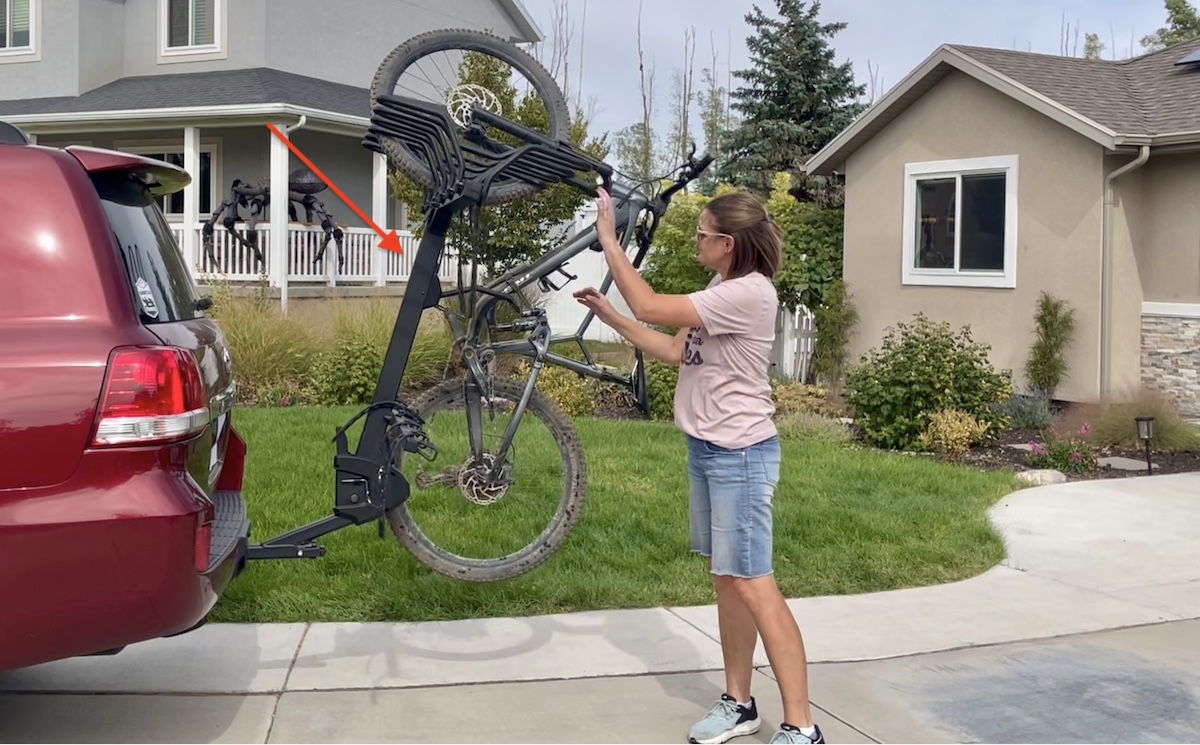
With one bike, the rack can move up rather quickly, so we recommend keeping a hand on the bike’s handlebar or a wheel basket when you pull the lever at first until you get used to how quickly the rack rises.
Safety Tips: Always make sure no one is standing between the rack and the vehicle when lifting. If the rack is empty or lightly loaded, it could rise quickly and potentially hurt someone standing by the bumper.
Interestingly, we noticed it’s slightly easier to raise the ReVert on high-hitch vehicles since the release bar is higher off the ground, making it more accessible (shown left). On lower-hitch vehicles, you might need to crouch slightly to release the lever (shown right).
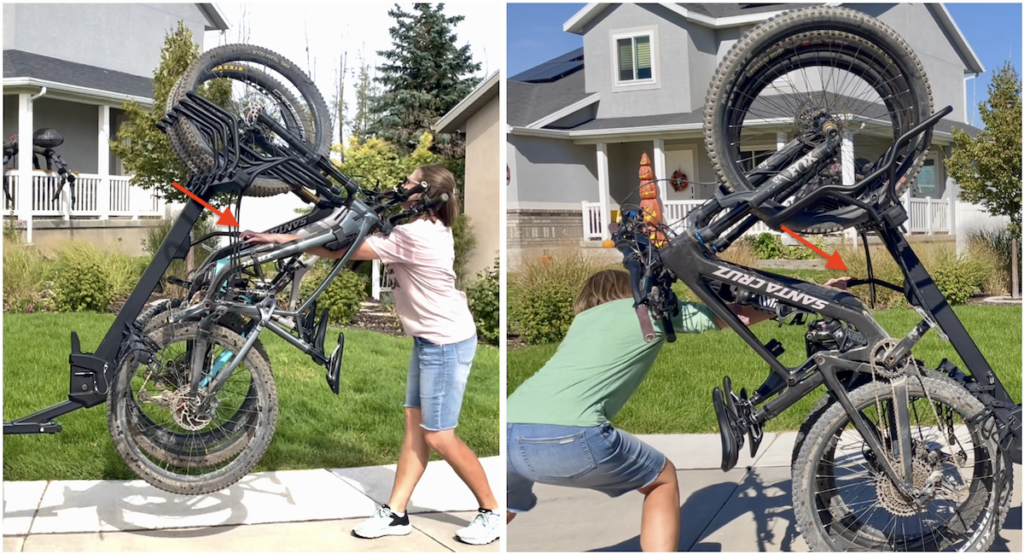
But no worries—you don’t need to stay in the crouched position when helping the rack back up. Once you’ve lowered the release bar fully into its slot, you can step back, stand up and push the rack up without holding the release down. It won’t lock back into place until it’s fully upright.
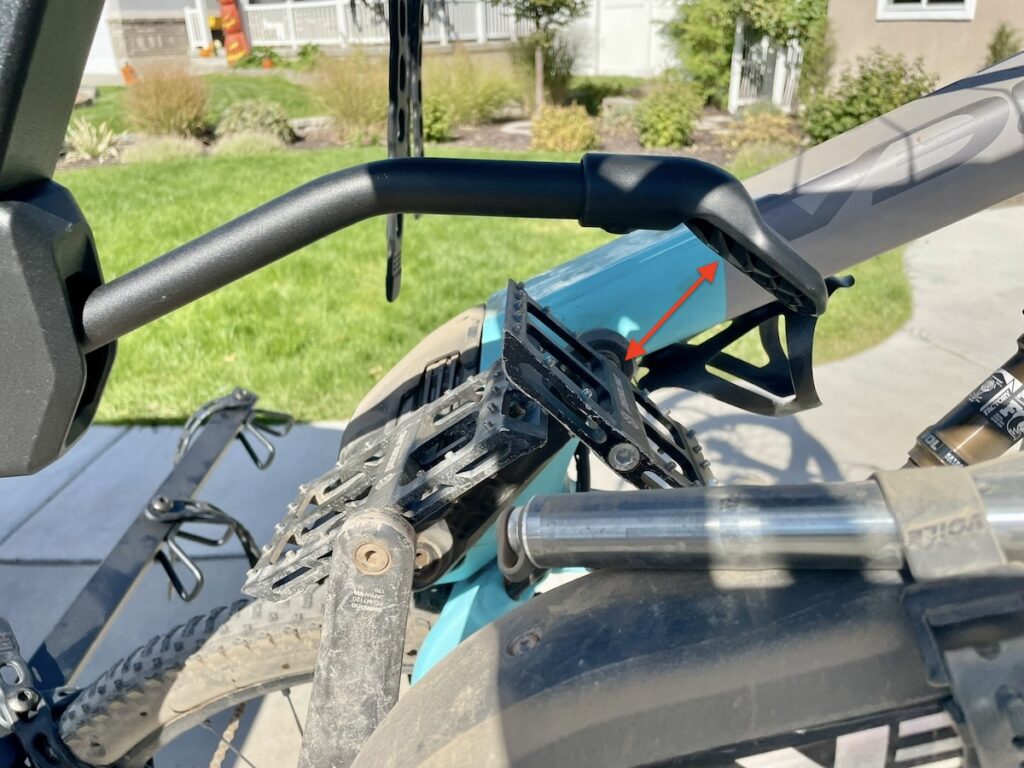
When pushing down the release arm, bike pedals can sometimes get in the way, so you’ll need to make sure they are moved out of the way first.
5. Reinsert locking pin
Once the rack is up, you’ll need to reinsert the pin, which is easier than with the VelociRAX or Alta racks. The VelociRAX pin requires some pinching and twisting to lock and unlock, while the Alta requires you to push up on the bikes to relieve pressure from the main mast before reinserting the pin.

Unloading the ReVert
Due to its stronger damper, designed to assist with lifting a fully loaded rack, a partially loaded ReVert often isn’t heavy enough to counteract the damper’s strength. While it reliably prevents bikes from dropping quickly under their own weight (like the VelociRAX), the Thule requires you to pull down on the bike basket to fully lower it when carrying lighter loads.

We didn’t find this particularly challenging—the added weight of even one bike makes it easier to lower than when empty. However, if you plan to use the rack primarily with a single bike (and only occasionally with 4 to 6 bikes), this could feel a bit tedious, and the easier-to-lower damper-free Alta might be a better option.
Once the rack is lowered, simply undo the wheel straps and roll the bikes out. After the rack is empty, pull the release lever, and the rack will quickly lift itself back into position. Occasionally, you may need to pull down slightly on the rack to fully disengage the release lever.
Finally, once the rack is back up, reinsert the locking pin.
Installing the Rack
Like any vertical rack, the ReVert requires a bit of muscle to lift due to its weight. The Thule 6-capacity model weighs 87.4 lbs, compared to the VelociRAX 6 at 98 lbs and the Alta GPR 6-capacity at 80.5 lbs. While they all pose a bit of a challenge to load, the Thule stands out because it doesn’t require any tools to install or remove—a feature we really appreciated, especially when finding the right wrench in our garage is often harder than it should be!
To install, simply insert the rack’s hitch arm into the vehicle’s hitch receiver. The Thule uses a built-in tightening arm that, once unlocked from the hitch body, rotates to secure the rack tightly to the receiver. As you turn the tightening arm, the hitch arm expands to grip the inside of the hitch receiver firmly.
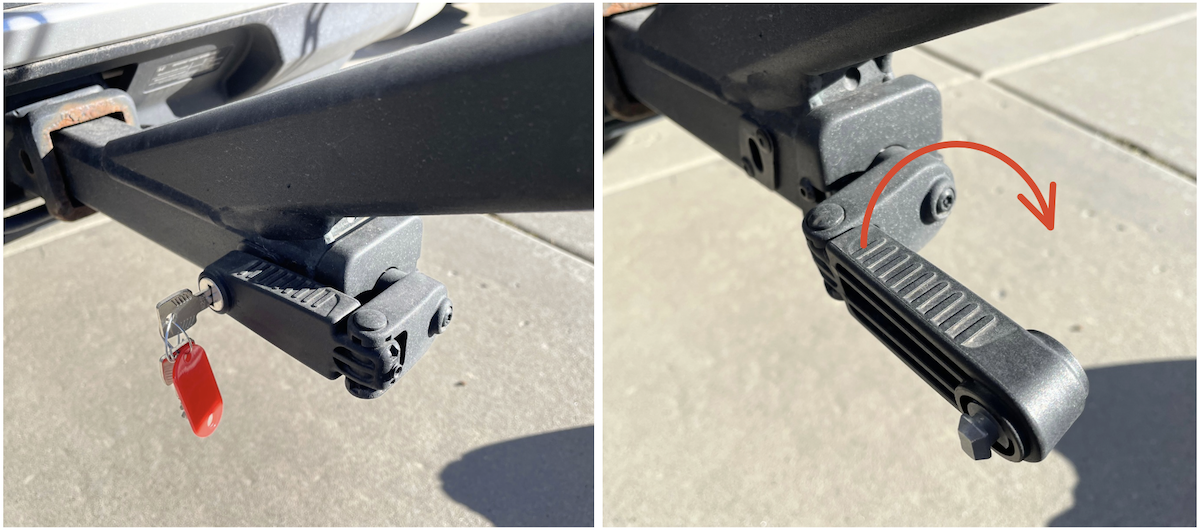
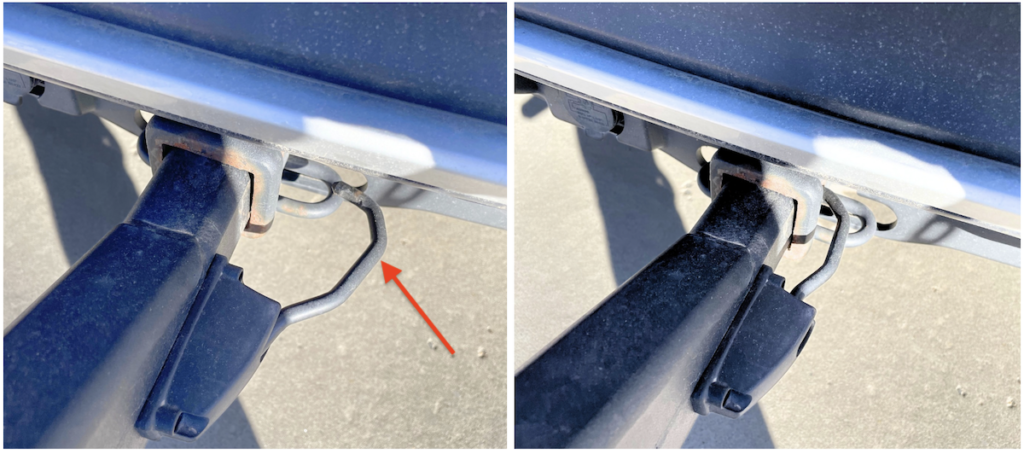
Another advantage of the ReVert is its integrated hitch pin, which means there’s no risk of losing it. This integration makes the pin super easy to install and remove.
Ground Clearance
One issue we encountered with the VelociRAX on low-clearance vehicles was its tendency to scrape when backing up or navigating steep transitions, like steep driveways or sharp drops on unpaved roads. With its raised hitch arm, this was never a problem on the Alta.
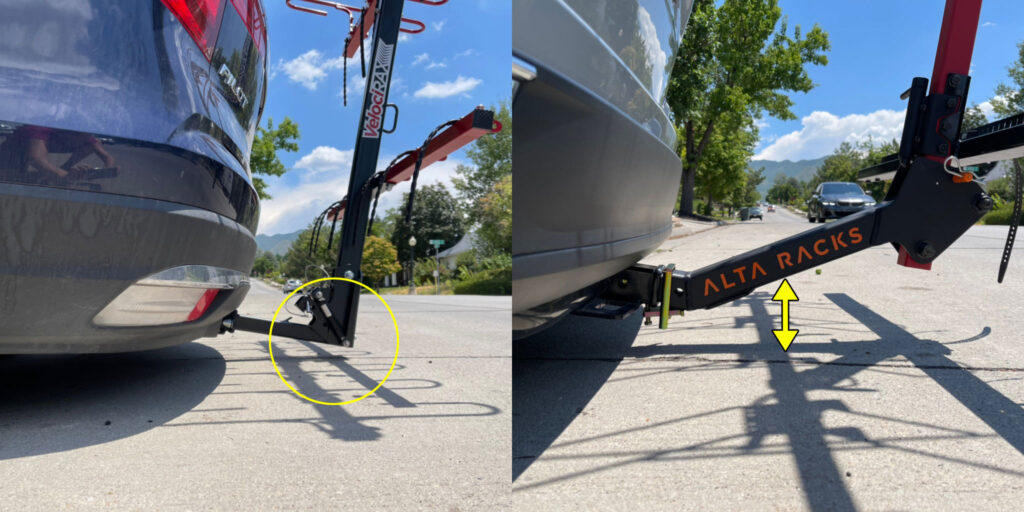
Although the Thule ReVert doesn’t offer quite as much clearance as the Alta, it has more than the VelociRAX, thanks to its shorter hitch arm. Measuring from the hitch receiver lip to the end of the arm, the Thule provides nearly 9 inches of clearance, compared to the VelociRAX’s almost 14 inches. After months of testing on various vehicles, we didn’t encounter any issues with the ReVert’s hitch arm scraping or bottoming out.

While carrying bikes on the Thule, we did notice our XXL Trek Fuel EX, with a 1323 mm wheelbase, slighlty touched the ground when backing up in our Highlander. Thule lists the max wheelbase for the ReVert at 1350 mm, so we were near it’s max. On our taller Land Cruiser, we had no clearance issues. As shown below, the rear wheels of the bikes extend further below the bumper in the Highlander than in the Land Cruiser.

In summary, if you have a tall vehicle, bike clearance shouldn’t be a concern. For standard-height vehicles, it may only be an issue with extra-long bikes.
“Feel” of the Rack Behind the Car
One of our favorite features of the Thule ReVert is also the hardest to describe. When driving with a fully loaded rack, you “feel” the rack and the bikes much less than with the VelociRAX or even the Alta (without side straps). After years of testing, we’ve noticed that the feedback from vertical racks is more noticeable on unibody cars than on body-on-frame vehicles. However, in both cases, all three of our test drivers experienced less feedback with the Thule than with the VelociRAX.
Parking in the Garage
We were able to pull into our garage with the ReVert fully loaded on our 2019 Toyota Highlander, but this was only possible because our garage has an arched entry. The added height of our 2008 Land Cruiser, however, was too tall to fit inside. For reference, the top of the arch of our garage is 8 feet.
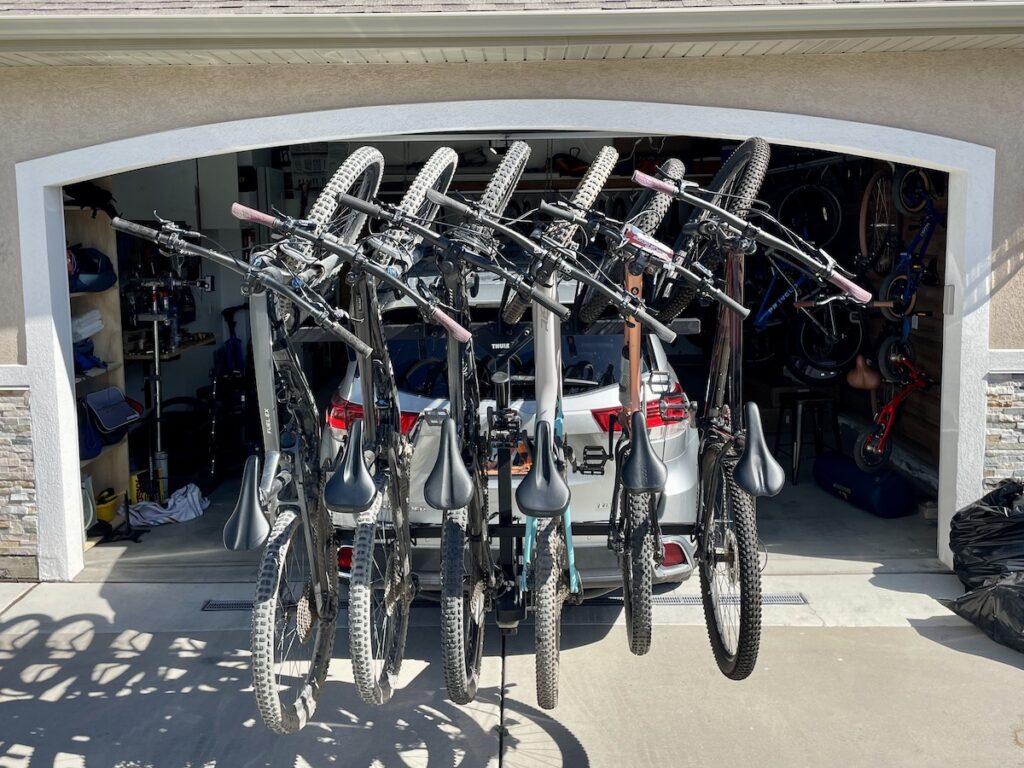
Of course, the height of any loaded vertical rack will vary based on the vehicle and the bikes. On our vehicles, the VelociRAX and Thule had similar measurements. Both racks extended about 26 inches from the hitch lip to the end of the baskets. From the top of the hitch bar to the top of the baskets, the VelociRAX measured 58 inches, while the Thule measured 57 inches.
Rear Hatch Clearance
The Thule’s tilt provides ample clearance to open the rear hatch of the Highlander as well as the clamshell hatch of the Land Cruiser. However, a full truck tailgate likely won’t be able to lower completely on either the Thule or the VelociRAX, though it can fully lower on the Alta.

Thule ReVert Add Ons
Thule offers four add-on kits for the ReVert: an integrated locking cable, a 20″/24″ wheel adapter, a bike repair stand, and a fat-tire wheel basket. We tested all of these add-ons except the fat-tire basket.
Bike Repair Stand
While no one plans to need a repair stand on the go, it’s invaluable when the situation arises. The Thule ReVert repair stand is simple to use and a worthwhile upgrade, especially for mountain biking trips or other adventures where repairs might be necessary.
The repair stand consists of a sturdy metal arm that bolts onto the rack’s bottom bar. When not in use, the arm locks securely into an upright position, staying out of the way and not interfering with the rack’s operation. When needed, the stand folds out easily for use.
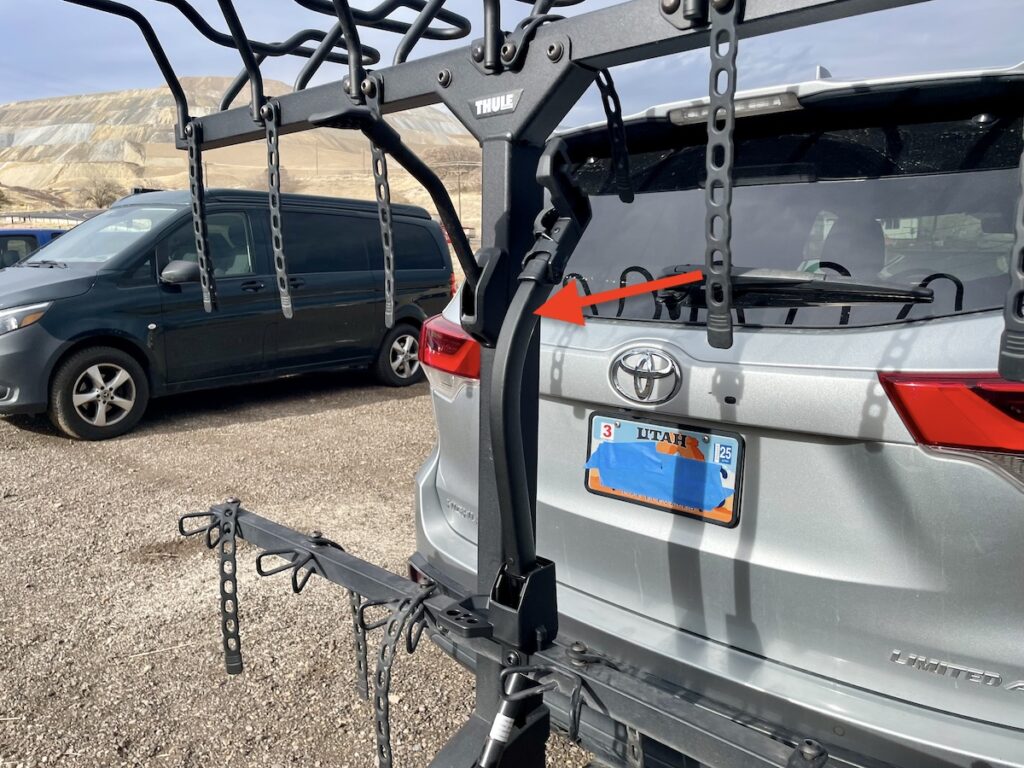
To use the stand, pull up to release the arm, then lower it until it snaps into place. Bikes attach via the seat post, with two arms securely hugging both sides of the post while the saddle rests on the upper arm. For bikes with a dropper post, the post must be extended to mount the bike properly. If your bike lacks a dropper post, you’ll need at least 7 inches of exposed seat post to secure it.
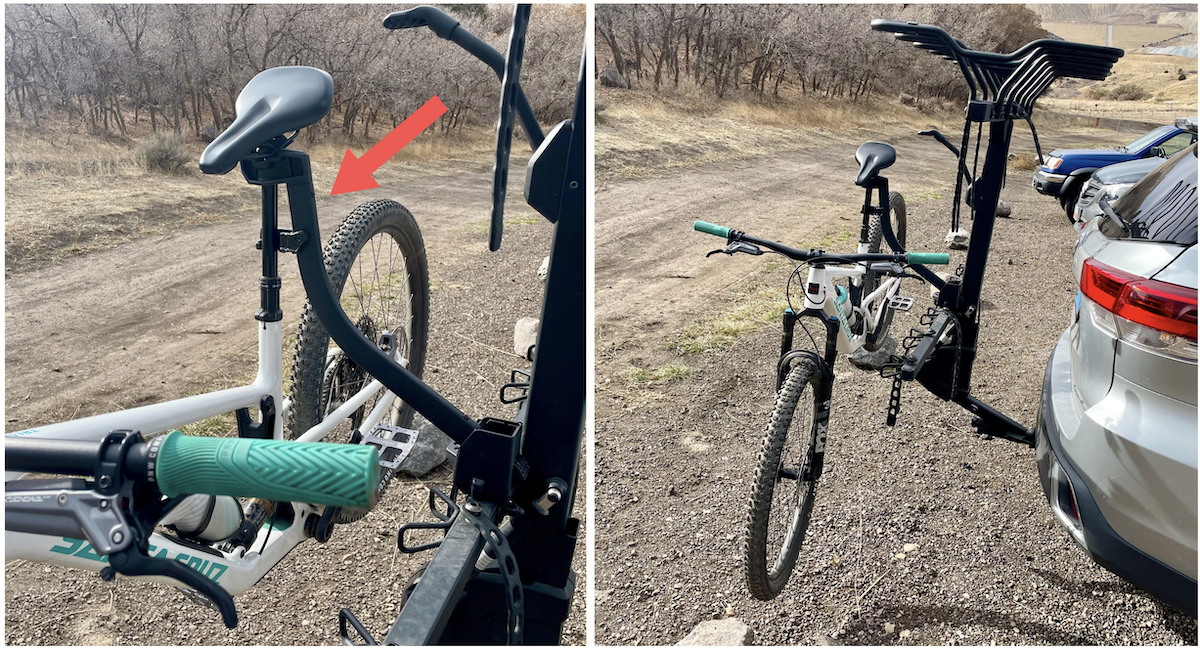
Once mounted, the repair stand securely holds bikes in place with minimal movement, making tune-ups quick and hassle-free. When mounted on our Highlander, my bike (large frame) sat a bit lower than I’d prefer (I’m 5’10”), but it was still perfectly usable without any major issues.

The front tire of my son’s XXL frame touched the ground while on the stand. We managed to lift the tire off the ground by mounting the bike with the dropper post slightly lowered, but this is not advisable as it could potentially damage the dropper. However, considering that most people with XXL frames likely drive larger vehicles, the repair stand’s height is unlikely to be a concern for most users.
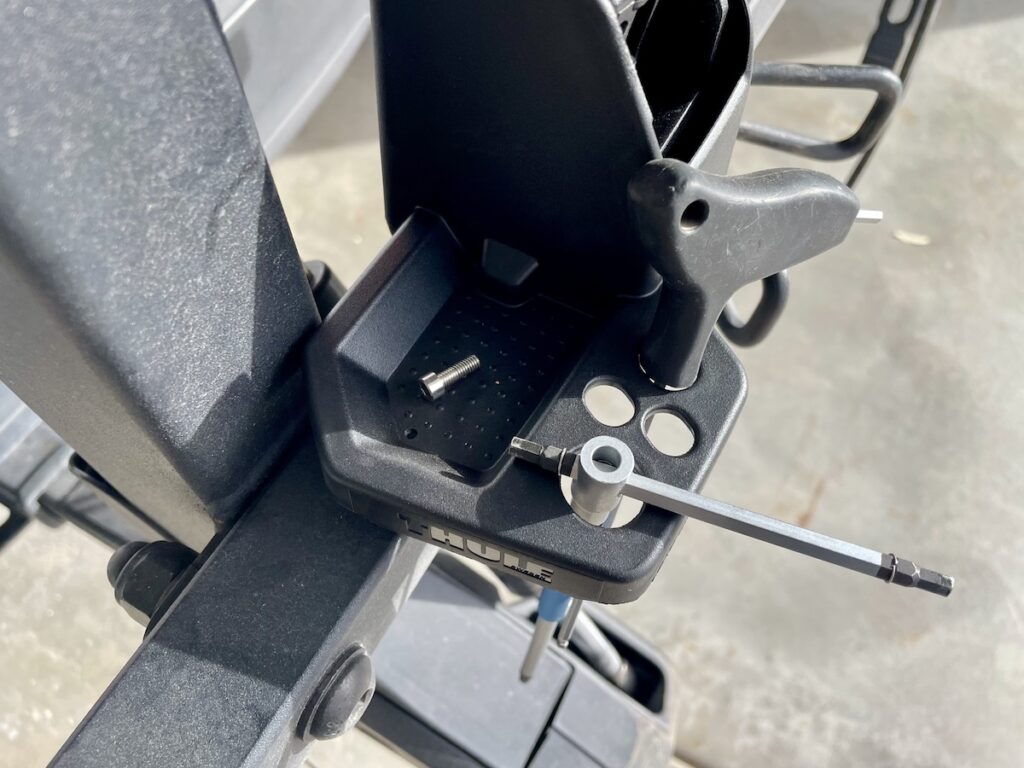
To keep bolts and tools organized, the repair stand features a convenient tray and dedicated slots for tools. However, accessing the tray requires reaching over the bike’s rear wheel, which might be slightly inconvenient depending on the repair task.
20″ and 24″ Wheel Adapter
The 20″/24″ wheel adapter snaps directly into the ReVert’s wheel basket without requiring any tools. However, it does take a bit of muscle to fully secure it in place. Since bikes on the ReVert should be loaded from largest to smallest (left to right, when standing behind the car), the adapter should be used in the rightmost basket.

For 20″ bikes, the adapter is absolutely necessary. Without it, the bike’s fork will hit the wheel basket, preventing the bike from fully settling into place. The adapter raises the wheel within the basket and allows the bike to hang over the right side of the basket. While the arrangement may feel awkward at first, it becomes intuitive after a few uses.
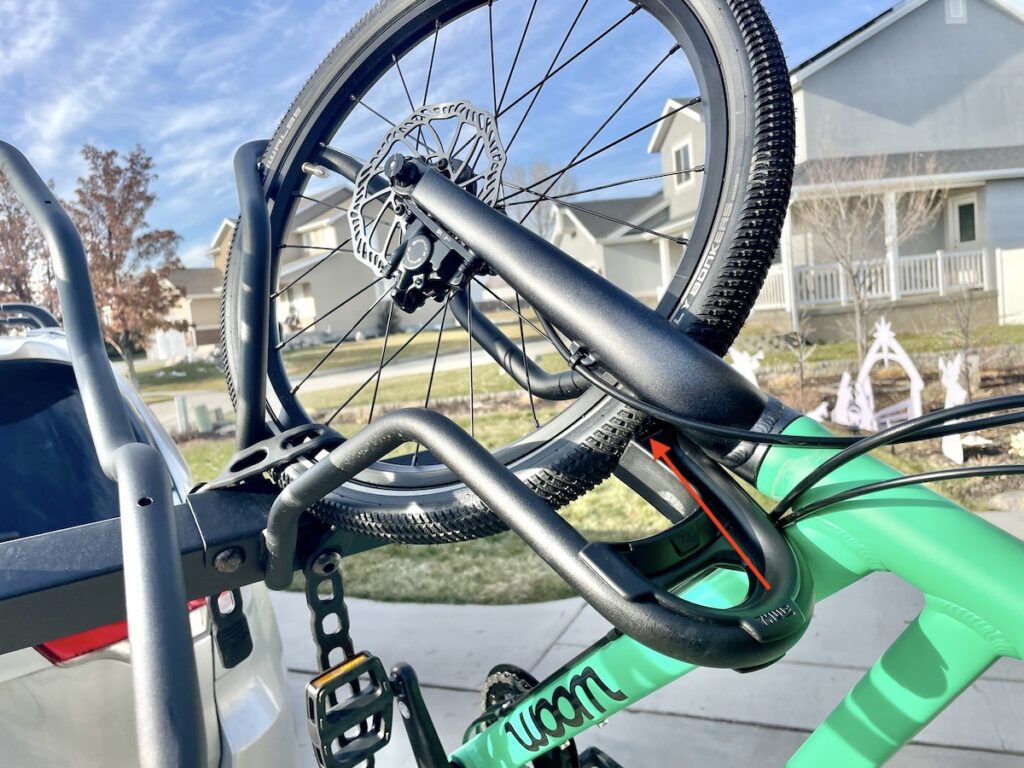
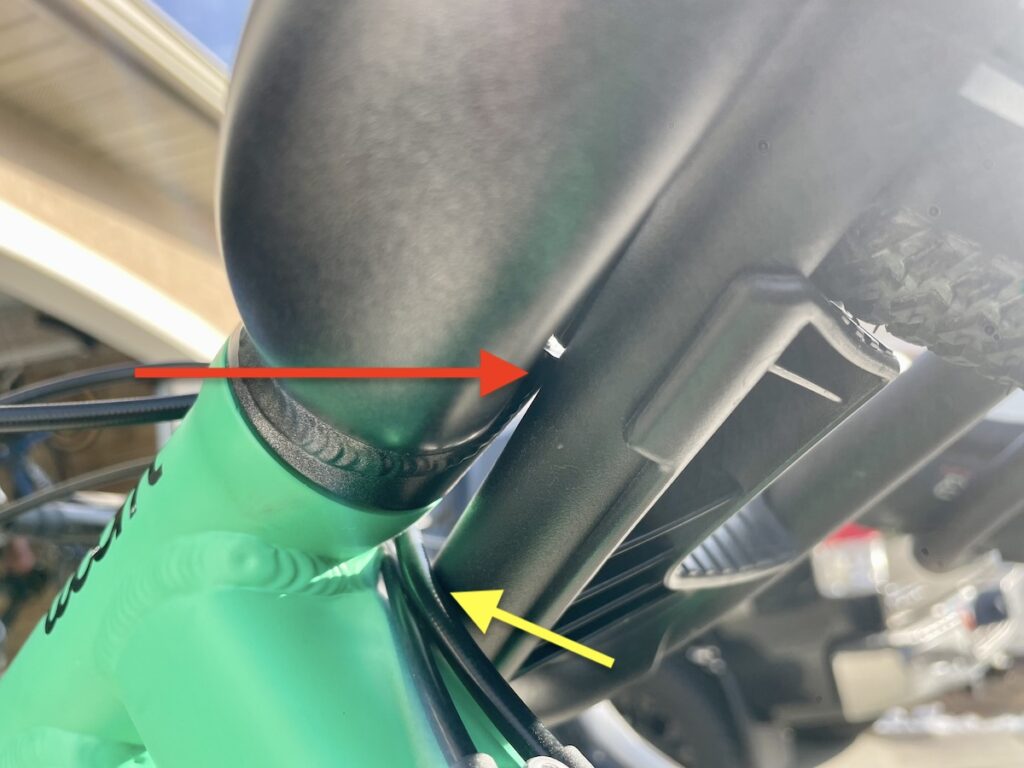
When fully strapped down, a small portion of the bike’s fork made contact with the basket (see red arrow in the image below). Despite this, the bike remained very secure with no shifting or bouncing. To prevent potential scratching during long trips, I recommend placing a thin piece of foam on the contact point.
While it appears there’s contact near the yellow arrow, this bike’s fork only came close without actually touching. However, adding foam at that spot as a precaution wouldn’t hurt.
The rear wheel of 20″ bikes also doesn’t extend to the bottom bar, but the strap is long enough to wrap around the wheel to hold it firmly in place.
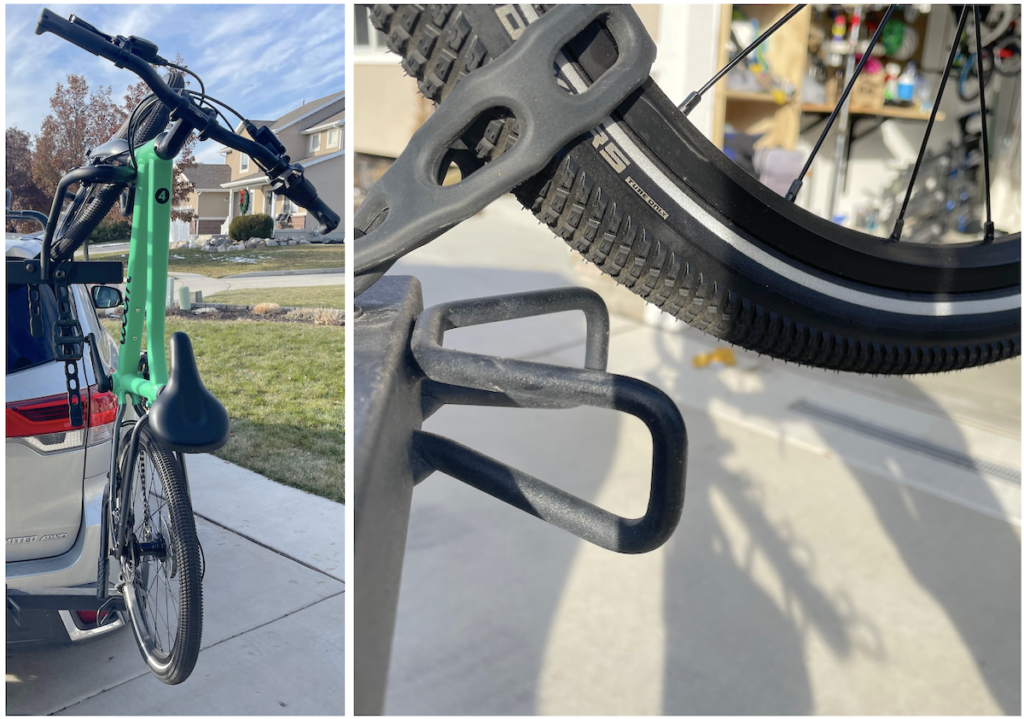
For 24″ bikes, the need for the adapter depends on tire size. Our 24″ bike with wider 2.35″ tires had enough clearance to prevent the fork from touching the basket. However, our 24″ bike with 1.5″ wide tires required the adapter to avoid contact between the fork and basket.

Integrated Bike Lock
The ReVert’s integrated bike lock consists of a heavy-duty external cable that secures into the bottom of the rack’s top bar. The locking mechanism is installed inside the top bar by removing the end cap, dropping the lock into place and then securing it to the rack with the included security bolts.
To lock bikes to the rack, the rubber-coated, thick-gauge metal cable is looped through the frame of the first bike, then threaded through the frames of the remaining bikes.
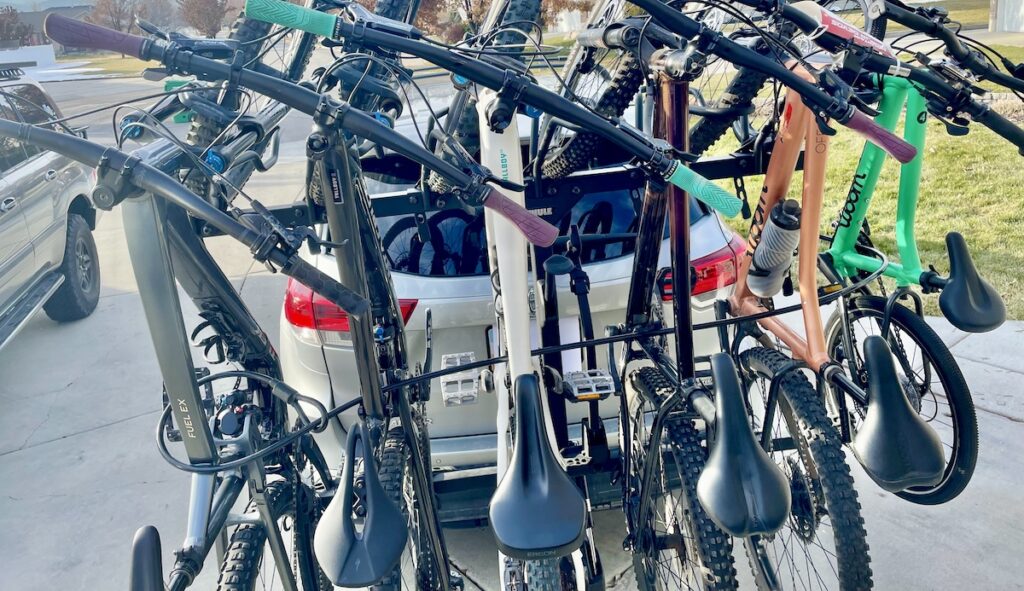
The cable’s large metal pin is then inserted into the bottom of the top bar and locked into place using Thule’s barrel lock system.

The locking system is straightforward to use and accommodates a wide variety of bike styles. However, as with any bike lock, it’s not theft-proof. Be mindful of where and how you leave your bikes secured to the rack, especially in high-risk areas.
Thule ReVert Bike Rack Bottom Line
Thule waited years to enter the vertical bike rack market, and it’s clear why. As the first vertical rack to truly help lift the bikes, it’s a game-changer. With additional perks like increased rear clearance and tool-free installation, the Thule ReVert stands out as the best rack for the average biking family.
For those who need a ski kit or a swing-out option for vans, however, the Alta or VelociRAX may be better suited.
To get a full rundown of all the car bike racks that we’ve tested, be sure to check out our Best Vertical Hitch Rack and Best Hitch Racks articles.
FTC Disclosure: Affiliate links are not included in this review. No monetary compensation was provided for this review. All opinions and images are that of Two Wheeling Tots LLC. All content and images are copyrighted and should not be used or replicated in any way. View our Terms of Use.