The Best 12 and 14 Inch Bikes for 3 Year Olds
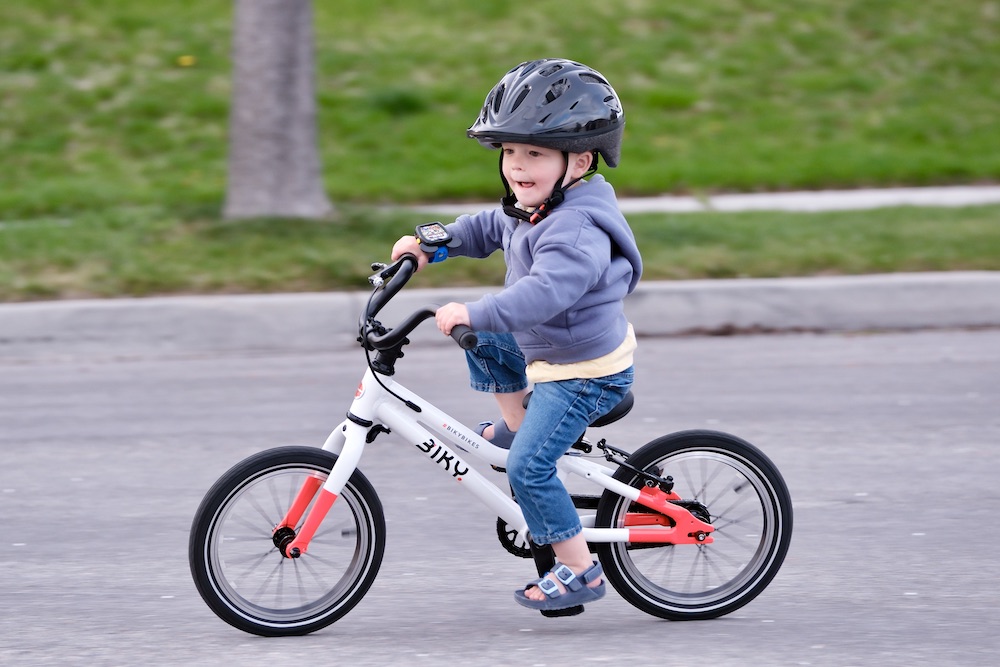
Watching your little one ride their first pedal bike is a special moment, but choosing the wrong bike can make it challenging. Many small pedal bikes are heavy and hard to ride, but we’re here to help.
Over the last decade, we’ve tested more than thirty 12 and 14 inch bikes with a flock of our kids and friends. From confident, 3-year-old balance bike graduates to timid 4-year-olds who prefer to use training wheels, we’ve seen it all and have a bike recommendation to match. Choosing the right bike is also key to keeping your child safe as they ride.
Some of the prices of bikes may give you sticker shock, but we promise you they are significantly easier to ride than bikes found at big-box stores and have high resale value. If you want additional help sorting through all your options, check out our Kids Bike Finder Tool.
The Best 12 and 14 Inch Bikes Rundown
| Bike | Why We Love It | Price |
|
Best for Use Without Training Wheels |
||
| Guardian Bikes 14 | Innovative SureStop Brakes | $249 |
| Biky Air 14 | Best Overall | $399 |
| woom 2 | Tried and True Favorite | $439* |
| Prevelo Alpha One | Best for the Shortest Riders | $419* |
|
Best For Use with Training Wheels |
||
| Guardian Bikes 14 |
SureStop Brakes + Training Wheel Kit |
$289 |
| Schwinn 14 Inch |
Works with innovative Flex Guiders Training Wheels |
$160** + $47 |
| Trek Precaliber 12 | Tool-free Training Wheels | $279** |
| Retrospec Koda 12 | Good design on a budget | $119** |
| Bikes We Don't Recommend | ||
| RoyalBaby Freestyle | Poor geometry and performance | $149** |
| REI Co-op REV 12 | Difficult to ride for the price | $219** |
| *Coaster brake, but removeable with optional freewheel kit, **Coaster brake | ||
Bike Buying Tips for 3-year-olds
- Pick the Right Size
Most 3-year-olds fit 12” or 14” bikes. If your child for their age or older, consider a 16” bike. - Balance Bikes vs. Training Wheels
Balance bikes are the easiest way to teach kids to ride—they’re faster, simpler, and often cheaper than bikes with training wheels. See our Best Balance Bikes page for options.- Prefer training wheels? Be aware that not all bikes are compatible, we’ve listed our favorites in this guide.
- Need help tranisitioning your balance bike rider to a pedal bike? Check out our How to Teach a Kid to Ride a Bike article.
- Bike Quality Matters
Higher-end bikes are lighter, easier to ride, easier to learn on and deliver better performance—but they can be pricey. To fit every budget, we’ve great options at various price points, all tested and approved by our kid bike experts. - Seat Height Is Key
Comparing the seat height of the bike to your child’s inseam is the best way to ensure a properly fitting bike.
・New riders: The seat height should match your child’s inseam so their feet can touch the ground for safe stopping.
・Experienced riders or using training wheels: The seat height should be about 2 inches taller than their inseam for better pedaling efficiency. Experienced riders will rely on brakes to stop versus their feet.
Best 12 and 14 Inch Bikes w/o Training Wheels
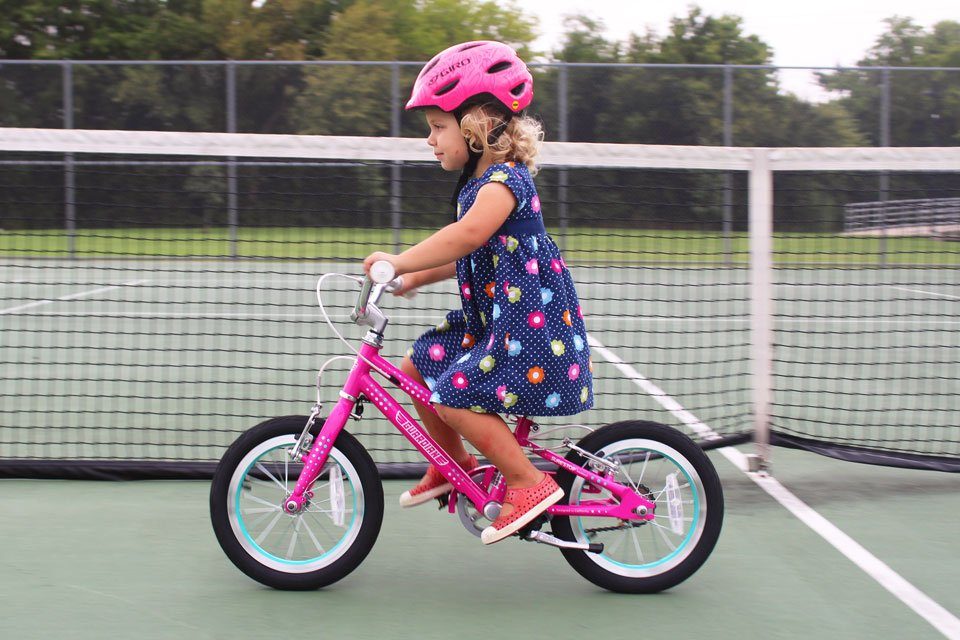
Guardian Bikes 14
$249
FITS KIDS: With inseams ranging from 16″ – 18”
SEAT HEIGHT: 16” – 20.8″
WEIGHT: 16 lbs.
BRAKES: SureStop dual-hand brakes
TRAINING WHEELS: Compatible, purchased as an add-on
HIGHLIGHTS: SureStop braking system, kid-friendly geometry, easy to balance, no coaster brake
Pros:
Cons:
Why We Love the Guardian 14
While there is a lot to love about Guardian Bikes, the proprietary SureStop braking system really makes them unique. SureStop brakes have a single brake lever on the right hand that activates both the rear and front brake.
With just one brake lever, you get all the stopping power you need! And as the cherry on top, the Guardian 14 does not have a coaster (back pedal) brake, which is a big benefit for little ones first learning to pedal.
SureStop not only makes braking faster, but also helps kids internalize proper braking technique from the get-go. As kids get older and ride much faster, braking with the front brake only (usually found on the left hand) can cause them to endo (flip over the handlebars). SureStop trains kids to rely on their right hand for braking.
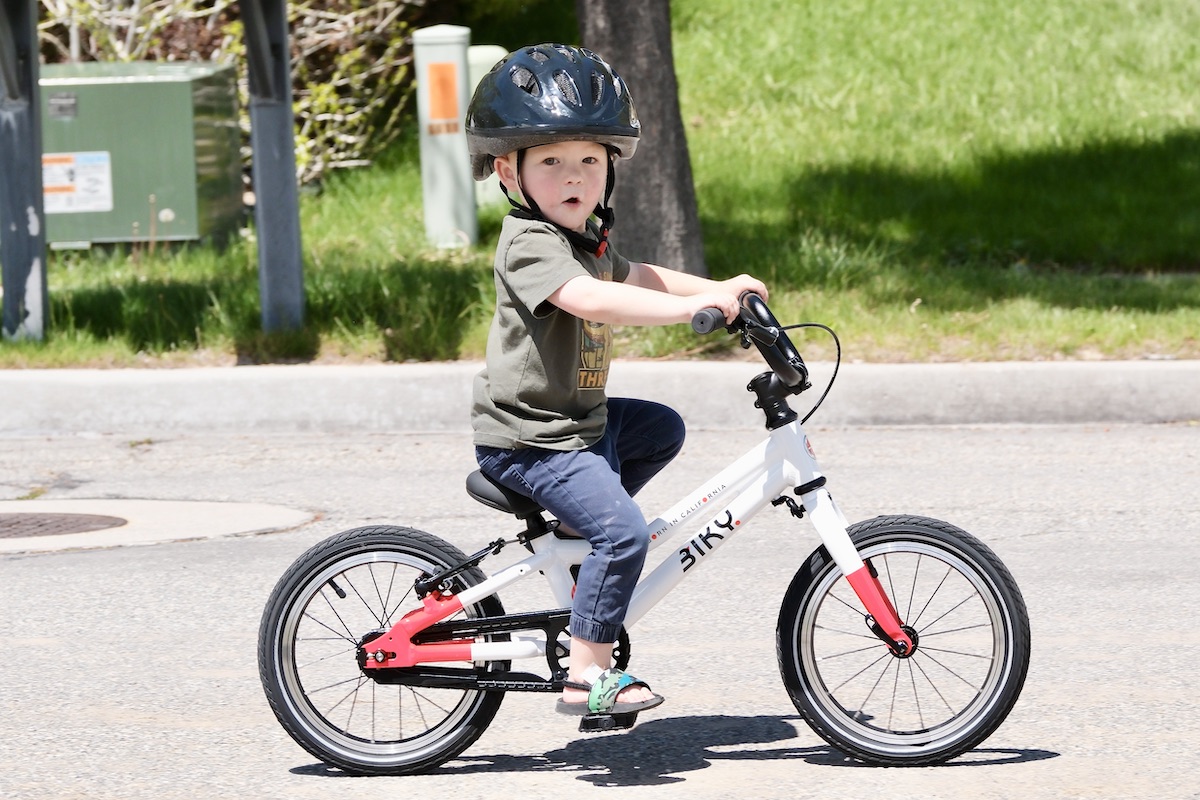
BIKY AIR 14
$399
FITS KIDS: With inseams ranging from 15.5″ to 20″
SEAT HEIGHT: 15.5” to 22.5″
WEIGHT: 11.5 lb.
BRAKES: Single rear hand-brake
TRAINING WHEELS: Not compatible
HIGHLIGHTS: Super lightweight, no coaster brake, longer wheelbase allows for plenty of room for growth
Pros:
Cons:
What We Love About the Biky 14
The perfect combination of size, adjustability, and ease-of-use, the BIKY AIR 14 is our top choice for little riders ready to get started on their pedaling adventures. With a low 15.5″ minimum seat height and coming in at just 11.5 lb., the Biky fits the tiniest of riders. On the tall end, Biky’s long wheelbase provides a wider base to fit riders up to 43″ tall without being super squished.
The longer crank arms on the Biky are unique in that they allow riders to reach top speeds without having to pedal ridiculously fast (which can be hard for little ones).
Unlike its competitors, the Biky 14 only has a single hand brake, our pack of kid testers never had an issue stopping the bike.
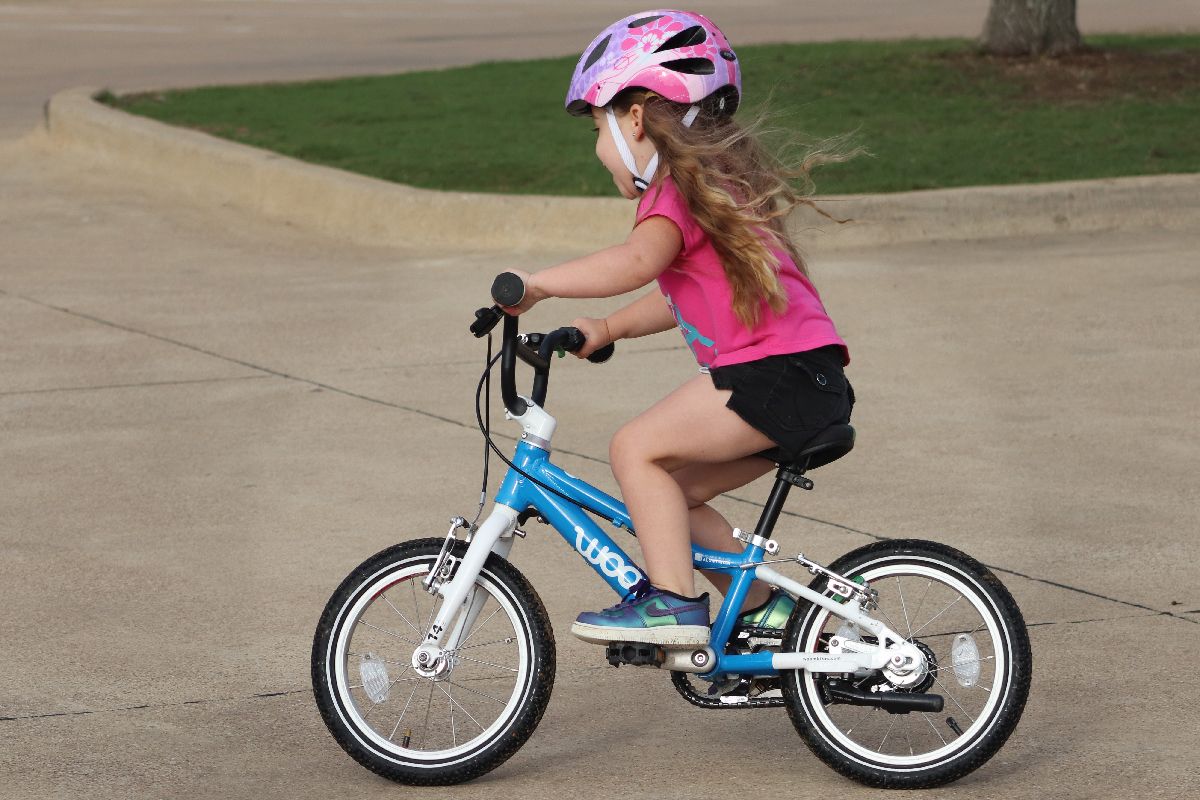
woom 2
$439 + $26 optional freewheel kit
FITS KIDS: With inseams ranging from 16″ to 17″
SEAT HEIGHT: 16” to 19.1″
WEIGHT: 12.3 lb. with coaster brake, 11.9 lb. with freewheel kit
BRAKES: Dual hand brakes
TRAINING WHEELS: Not compatible
HIGHLIGHTS: Super lightweight, dual hand brakes, every detail fine-tuned to fit the smallest riders
Pros:
Cons:
Why We Love the woom 2
Easy and intuitive, the woom 2 is an exceptional first pedal bike for balance bike graduates. In addition to being lightweight, the woom also has a smart combination of top-end components, bike geometry, and brake design that work in unison to create a natural, fun, riding environment.
The woom 2’s unique geometry centers the child’s weight over their hips (just like when standing), and keeps a child in a comfortable, upright position. This allows the bike and the child’s body to work together in a natural and easy process.
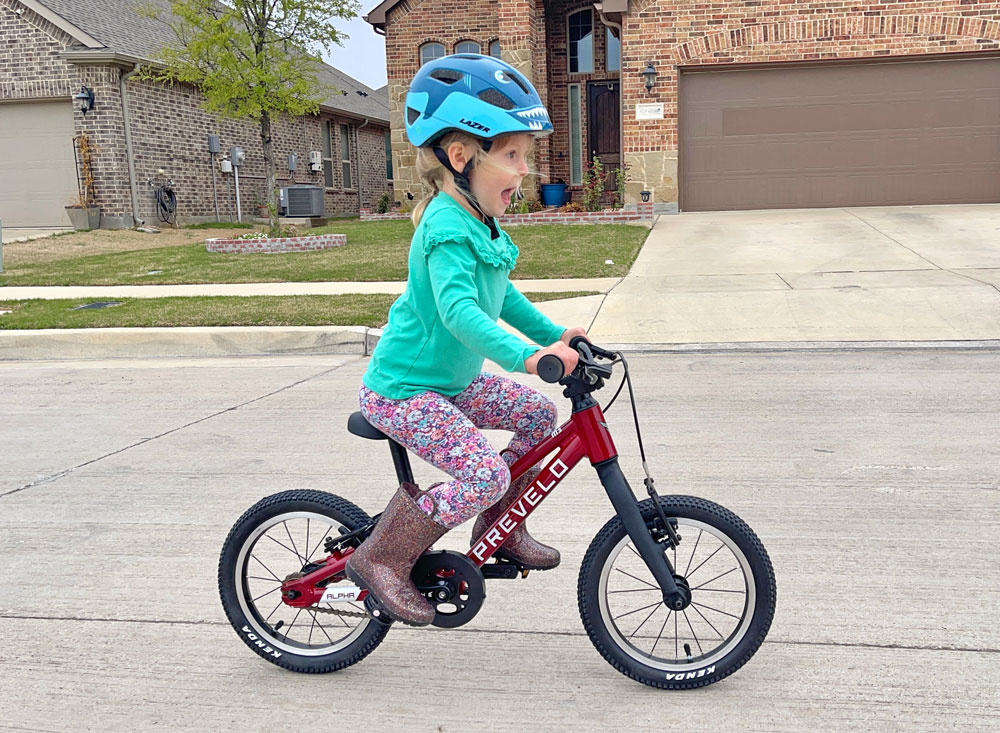
Prevelo Alpha One
$419 + $49 optional freewheel kit
FITS KIDS: With inseams ranging from 14.8″ to 17″
SEAT HEIGHT: 14.3” to 19.3″
WEIGHT: 13.3 lb. with optional freewheel kit installed (heavier without it)
BRAKES: Dual hand brakes
TRAINING WHEELS: Not compatible
HIGHLIGHTS: Lightweight and nimble, MTB-styling
Pros:
Cons:
What We Love About the Alpha One
The Prevelo Alpha One is one impressive and tiny bike for the smallest and most eager balance bike graduates. With high-end components, sophisticated, yet kid-specific design, and durability to last through several kids, you’ll be wishing you were small enough to ride it.
With lower-set handlebars than most other bikes on this list, the Alpha Zero is a solid choice for aggressive balance bike riders ready to tackle pedals. The lower handlebars allow for more of the child’s weight to be over the handlebars, which helps the aggressive rider to better maneuver and control the bike.
And with the lowest seat height of any 12″ or 14″ bike on the market in the US, the Alpha One is a much needed solution for parents with tiny groms who are ready to tackle the world of two wheels and pedals… and just can’t wait for a bigger bike!
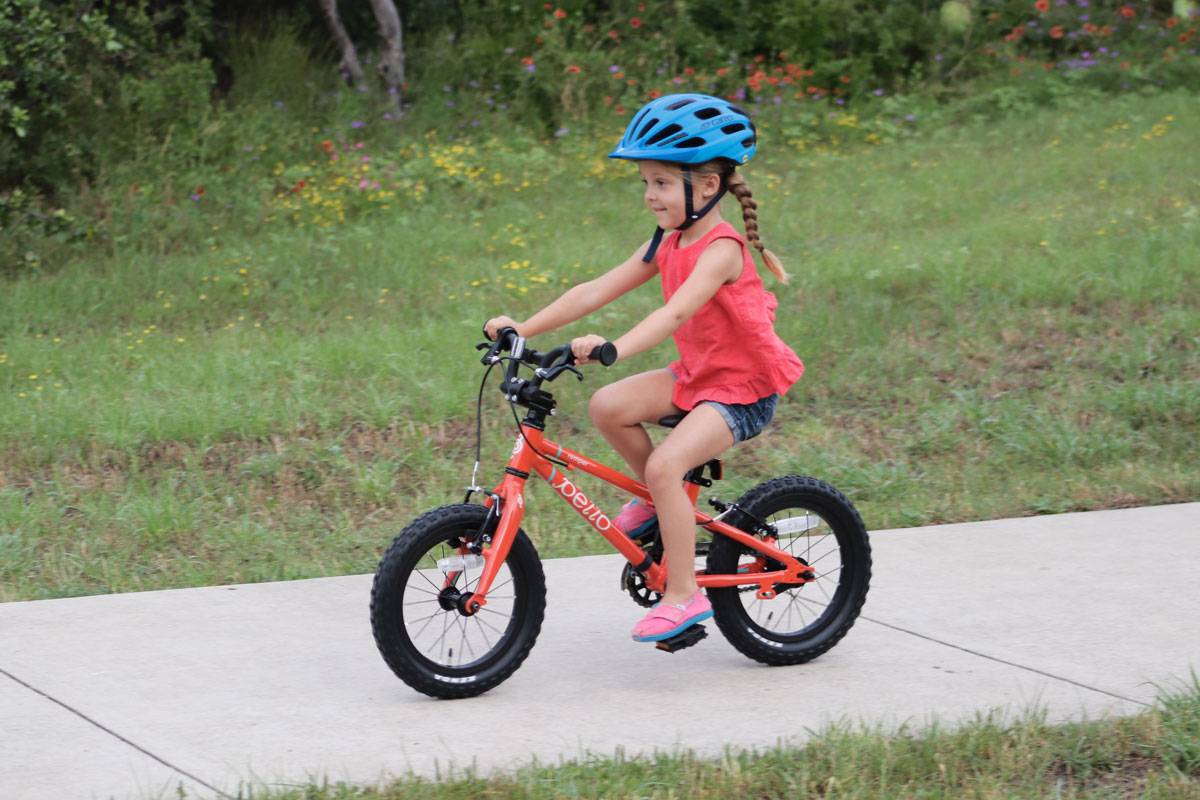
Pello Romper 14
$369
FITS KIDS: With inseams ranging from 17.25″ – 19″
SEAT HEIGHT: 17.5” – 21.75″
WEIGHT: 15.9 lb.
BRAKES: Dual hand brakes
TRAINING WHEELS: Not compatible
HIGHLIGHTS: Durable build, high-end components, MTB-styling
Pros:
Cons:
What We Love About the Romper
From Kenda tires and Tektro brakes to Cane Creek headsets and lightweight aluminum frames, Pello Bikes ooze quality while excelling on paved bike trails and single-track dirt trails. On paved rides, little ones can happily keep up with the older kids in the pack, while on single-track, the knobby tires provide much-needed grip for rocky trails.
With a minimum seat height about 1.5 – 2” taller than our other favorite bikes on this list, the Pello Romper will be a better fit for kids transitioning to a pedal bike around 3 or 3.5 years old. While there are some 16″ bikes with saddles as low as the Romper, less-confident kids are better off learning to pedal on a 14″ bike which is less cumbersome for them to maneuver.
Best 12 and 14 Inch Bikes with Training Wheels
All of these bikes, including the Guardian 14 listed above, are compatible with training wheels. However, not all bikes come with training wheels included in the box, so be sure to double-check before ordering.
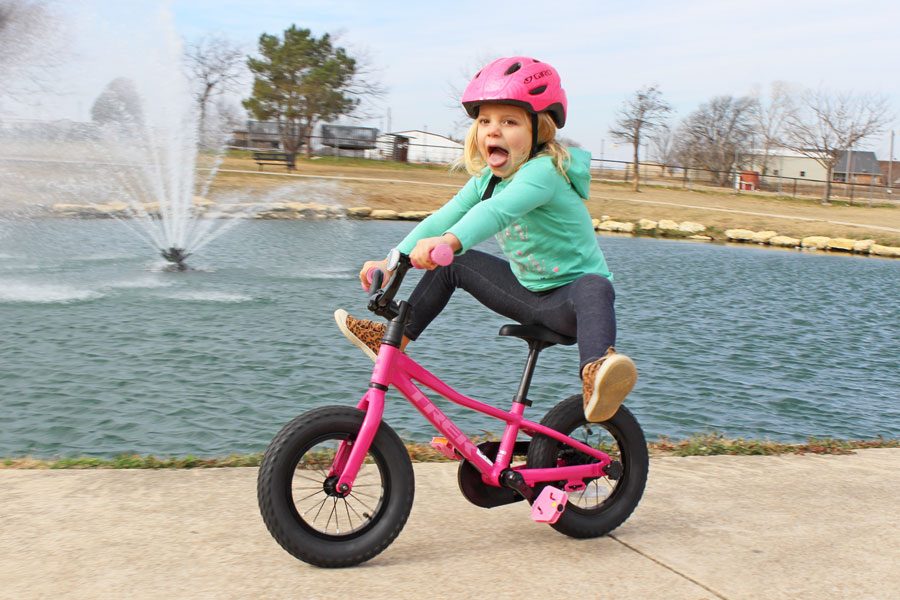
Trek Precaliber 12
$279
FITS KIDS: With inseams ranging from 15″ to 16″.
SEAT HEIGHT: 15.25” – 18.75″
WEIGHT: 14.3 lb. (without training wheels)
BRAKES: Coaster brake only
TRAINING WHEELS: Comes with training wheels, which attach via a knob – no tools required!
Pros:
Cons:
What We Love About the Trek Precaliber 12
Our favorite 12″ bike found online or in local bike shops, the Trek Precaliber boasts similar geometry to the high-end bikes on this list. It also has one of the lowest minimum seat heights, which makes it a great choice for kids transitioning to a pedal bike early.
While other bikes seem like “clown bikes” as kids get taller and older, our 40.5″ tall three-year-old rode the Precaliber 12 at its maximum seat height and still looked comfortable and natural.
With solid and durable components and wider tires for increased stability, the Precaliber 12 is a great quality bike for the price. The Precaliber’s coaster brake and lack of hand brakes is reflected in its lower price tag.
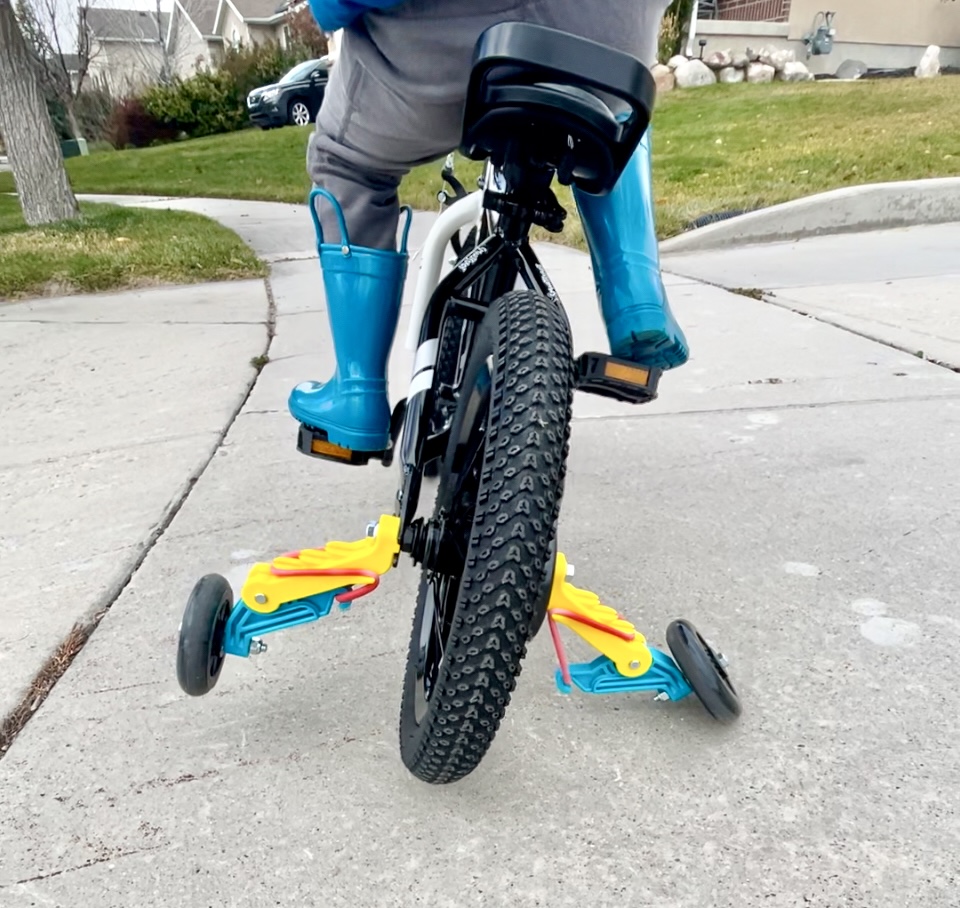
Schwinn 14 + Flex Guiders Training Wheels
$160 (bike) + $47 (Flex Guiders training wheels)
TRAINING WHEELS: Purchased separately, help kids balance instead of enabling them
What We Love About the Flex Guiders
If your child isn’t interested in a balance bike but you want to avoid the frustrations of traditional training wheels, Flex Guiders training wheels are an excellent alternative. Designed to support young riders as they learn to pedal, these training wheels provide just enough stability without allowing kids to become overly reliant on them.
Unlike traditional training wheels, Flex Guiders let the bike naturally lean into turns. This not only stabilizes the bike but also helps kids understand that leaning is a normal and necessary part of riding. Traditional training wheels discourage leaning, which can create bad habits and make transitioning to two wheels more challenging. Flex Guiders strike the perfect balance—offering support while still teaching essential riding skills.
Currently, Flex Guiders are only compatible with 14” bikes that have a long rear axle. As a result, they don’t fit the 12” or 14” bikes we recommend. However, they are compatible with the Schwinn Koen or Elm 14. While these Schwinn models may not match the overall performance of the other bikes on our list, they work with Flex Guiders—making them a great choice for this innovative training wheel option.
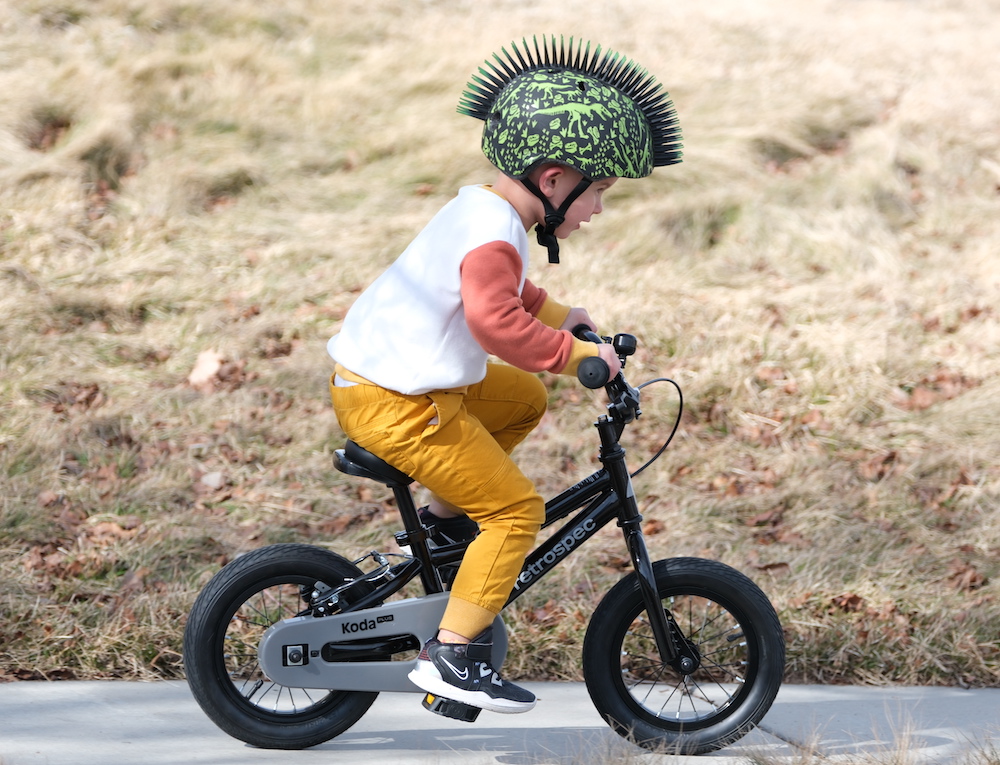
Retrospec Koda 12
$119
FITS KIDS: With inseams ranging from 15.5″ to 17″.
SEAT HEIGHT: 15.5” – 18″
WEIGHT: 17 lbs.
BRAKES: Rear hand brakes, coaster brake
TRAINING WHEELS: Included
Pros:
Cons:
What We Love About the Retrospec Koda Plus
If you’re on a tight budget and you plan on having your little one use training wheels, the Retrospec Koda 2 is a great bang for your buck. This 12 inch bike offers significantly better geometry than similarly priced-bikes, and is also more lightweight and better quality.
While the Retrospec can certainly be ridden without training wheels (as shown above), it isn’t ideal. Like the REI 12″ below, the crank arms are really short which makes it hard for kids to pedal quickly (their feet easily fly off the pedals).
Since kids can’t pedal as fast on a bike when it has training wheels, not only will their feet not fly off the pedals as much, but pedaling backwards to engage the coaster brake is easier, despite the short crank arms. As a result, the Koda 12 bike is suitable for use with training wheels only.
The Retrospec Koda 2 Plus has a handbrake in addition to the coaster brake, but it is hard to engage and only helps to slow the bike down, not stop it completely. Kids will need to use the coaster brake in addition to the hand brake to stop on the Plus model.
Other Bikes to Consider
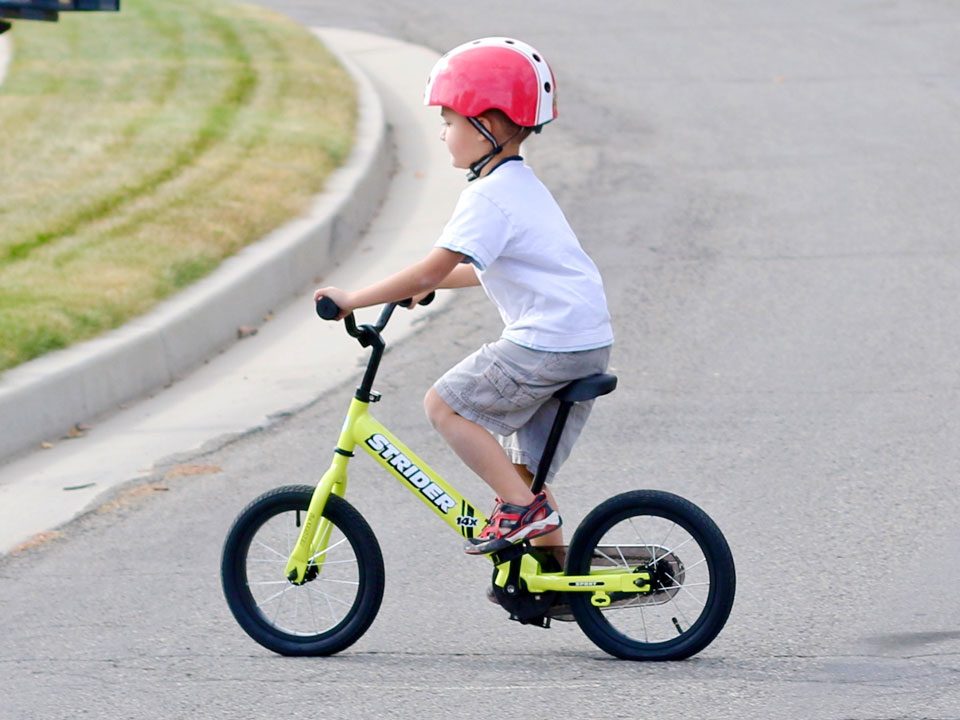
Strider 14x
$219
FITS KIDS: While the manufacturer recommends from ages 3 to 7, based on our testing, we recommend only from ages 3 to 5, or with inseams ranging from 15″ to 20″ in balance bike mode and 14″ to 20″ in pedal bike mode.
SEAT HEIGHT: 15″ – 22″
WEIGHT: 12.5 lb.
BRAKES: Coaster brake on pedal assembly
Pros:
Cons:
What We Love About the Strider 14x
A great option for preschoolers who have yet to master a balance bike, the Strider 14x is a balance bike that converts to a 14 inch pedal bike. No need for training wheels – once a child has learned to balance while in balance bike mode, simply put on the optional pedal kit and within a couple of minutes they’ll be pedaling away! Once your child outgrows the pedal bike mode, they will be ready for a 16″ bike.
Due to taller handlebars, the Strider is best for taller 3-year-olds and up. The longer reach between the seat and the handlebars is a bit too much for preschoolers, who are much better off on the standard Strider 12″ Sport. Based on our experience, the Strider is ideal for kids in size 5 clothes or less.
For other convertible balance bikes, check out our Balance Bikes with Pedals list.
12 Inch Bikes we DON’T RECOMMEND
Don’t purchase a bike based on Amazon’s best-seller lists or their reviews! If there was a cheap bike on Amazon that was better than any of the bikes we recommend, we would absolutely recommend it – but there isn’t (and was constantly check).
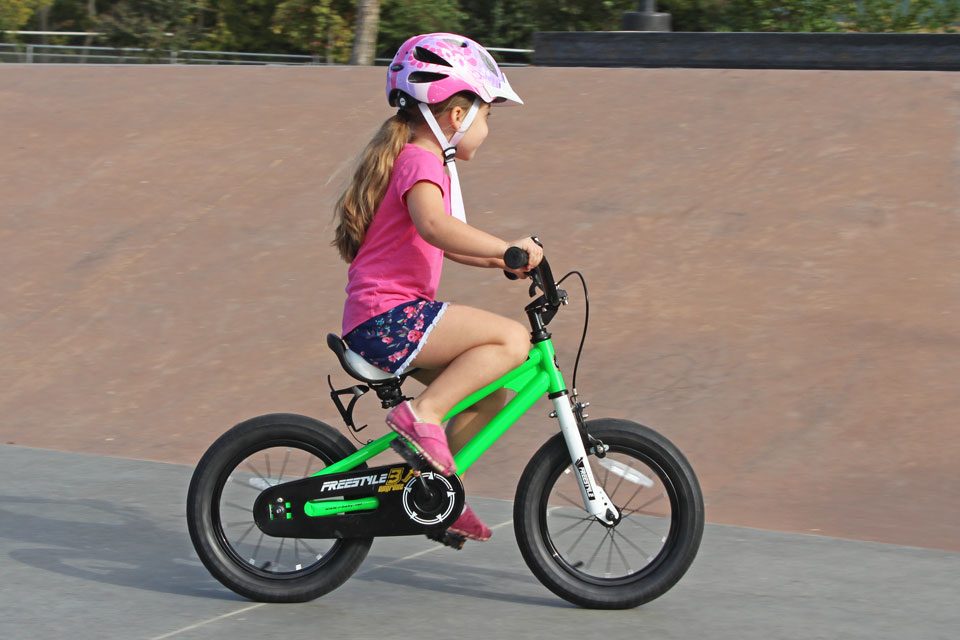
RoyalBaby Freestyle
$150
FITS KIDS: With inseams ranging from 15″ to 17.5″
WEIGHT: 21.7 lb. (14″, with training wheels
BRAKES: Coaster brake, front hand brake
TRAINING WHEELS: Included
Pros:
Cons:
Why We Don’t Like the RoyalBaby Freestyle
Besides being very heavy, the biggest problem with the RoyalBaby Freestyle 14-inch and 12-inch bikes is the bike’s poor frame design and seat height combination. The frame’s size and the room in the cockpit (distance between the saddle and the handlebars) are appropriate for a child on the smallest end of their sizing range, but the minimum seat height is too tall for those kids to safely ride it.
A child that looks like a good fit on the RoyalBaby Freestyle can barely touch the ground with their toes, or even not at all! Once a child is tall enough to comfortably touch the ground to help themselves safely stop, they are too tall in comparison to the size of the bike’s frame. This leads to a cramped and awkward ride.
Additionally, our test riders found the Freestyle pretty difficult to get started pedaling.
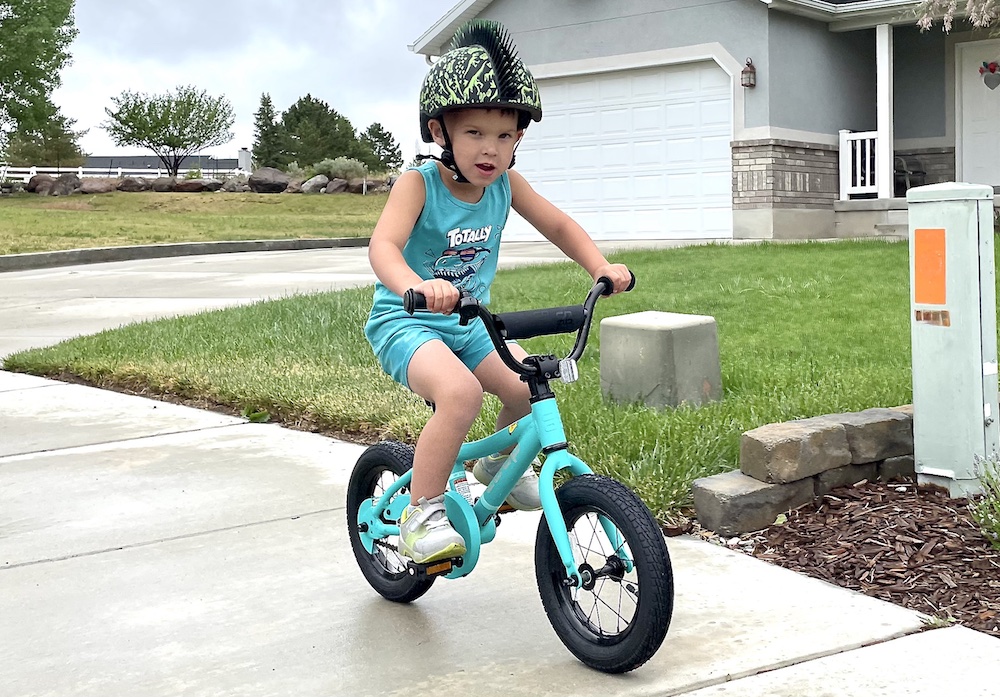
REI Co-op Cycles REV 12
$219
WEIGHT: 15.8 lb. (without training wheels)
TRAINING WHEELS: Comes with training wheels.
BRAKES: Coaster brake only
Pros:
Cons:
What We Don’t Like the REV
REI’s Co-Op Cycles are popular for their good quality, fair prices, and REI guarantee, but unfortunately, we cannot recommend their Co-op Cycles REV 12. Due to its short crank arms, our testers found the REV 12 challenging to pedal as their feet often flew off the pedals.
The small crank arms also made it challenging to activate the coaster brake (back pedal brake). While training wheels help negate some of these issues because kids can’t ride as fast, we just don’t think this bike is worth its price compared to other bikes on this list.
The REV also does not have the option of a handbrake like the Retrospec Koda Plus model.
Note: Models sold from 2022 to Spring 2024 were recalled by the CPSC due to their poorly designed training wheels.
How to Choose the Best Bike for 3-Year-Olds
As parents ourselves, we know it’s hard to resist purchasing the first cute bike you see for your little rider! Whether it’s princess or superhero-themed, the anticipation of seeing your little one’s eyes light up upon seeing the bike is SO tempting. But after years of experience, we can assure you that those cute bikes at the big-box store, quickly lead to frustration and tears.
Those cute (and often cheap) bikes are designed to primarily look super cute. They are NOT designed to properly fit small kids or make learning to ride easy. So what should you look for when buying a bike? From proper fit to brakes, here’s our breakdown of what’s really important when shopping for the best bike for your 3-year-old.
Size – What height are 12 and 14 inch bikes for?
12 and 14 inch bikes are the best fit for 2 and 3-year-olds who are 36″ to 44″. If your child is older than 3, a 16″ bike should also be considered to allow for more room for growth. If they are shorter than 36″ or are not yet in 3T pants, they are better off on a balance bike.
Whether you should get your child a 12 inch or a 14 inch bike really depends on the size of the bike rather than the size of your child. Some 14 inch bikes even have lower seat height ranges than 12 inch bikes! For example, the minimum seat height of the green 14 inch bike on the left is over 3.5” taller than the minimum seat height of the silver 14 inch bike on the right.
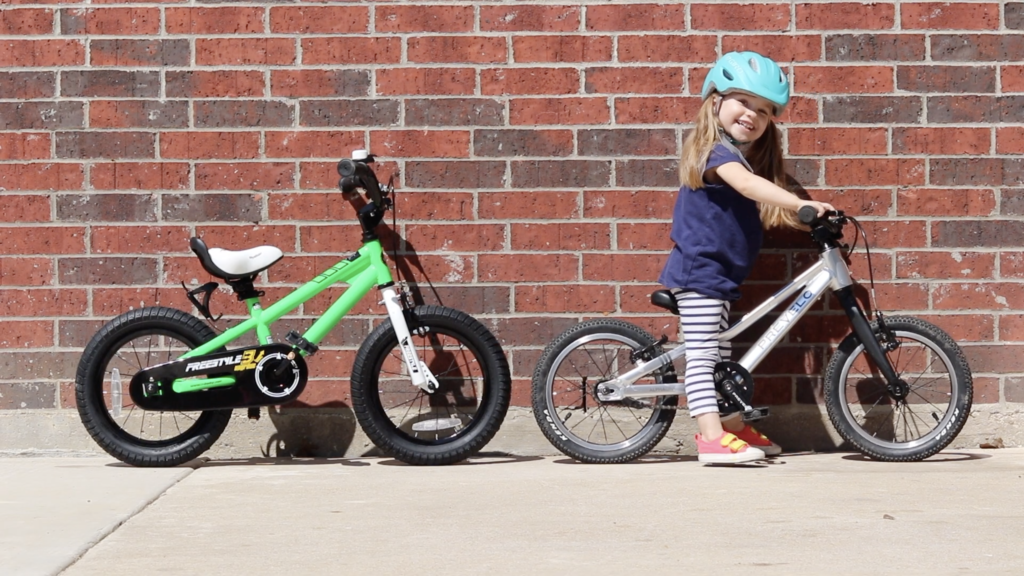
So instead of looking at the size of the bike’s wheels, it is best to look at the minimum and maximum seat height of the bike (provided in our mini-reviews above). When purchasing a bike for new riders, you ideally want the child’s inseam to match or be slightly under the minimum seat height of the bike (How to Measure a Child’s Inseam).
Why does the seat need to be set so low?
Having the ability to set the bike’s seat to a child’s inseam (or just below) is important for three reasons.
(1) It allows them to balance the bike while comfortably standing over it. Learning to ride a bike can be very intimidating, so eliminating nerves every step of the way is helpful.
(2) With the seat set lower than, or at, the child’s inseam, they will be able to easily stop the bike with their feet when they are nervous or forget to brake.
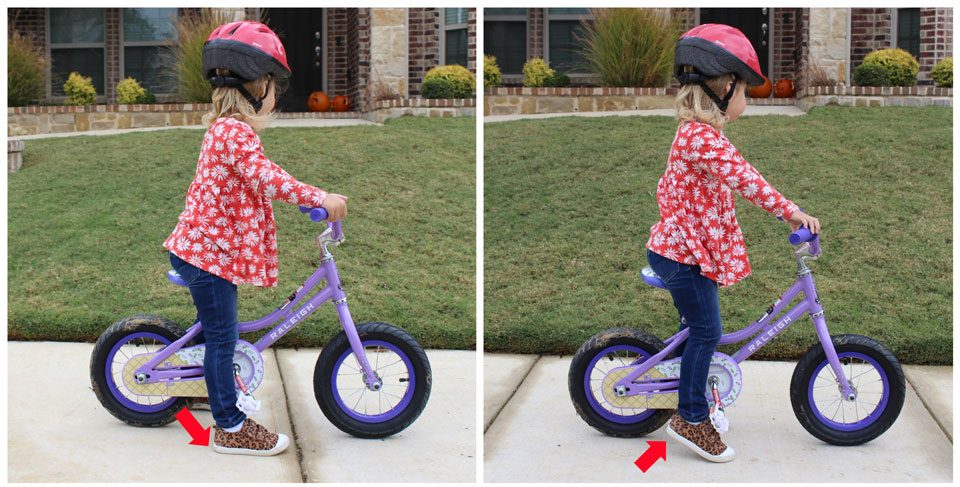
(3) It allows kids to get a running start before they start to pedal (kids run by putting their feet behind the pedals). A running start is key to helping new riders, especially balance bike graduates, learn to master pedaling. A bike in motion is much more stable than a stationary bike, so don’t teach your child to pedal from a stop (they naturally pick this up as they get older and more confident).
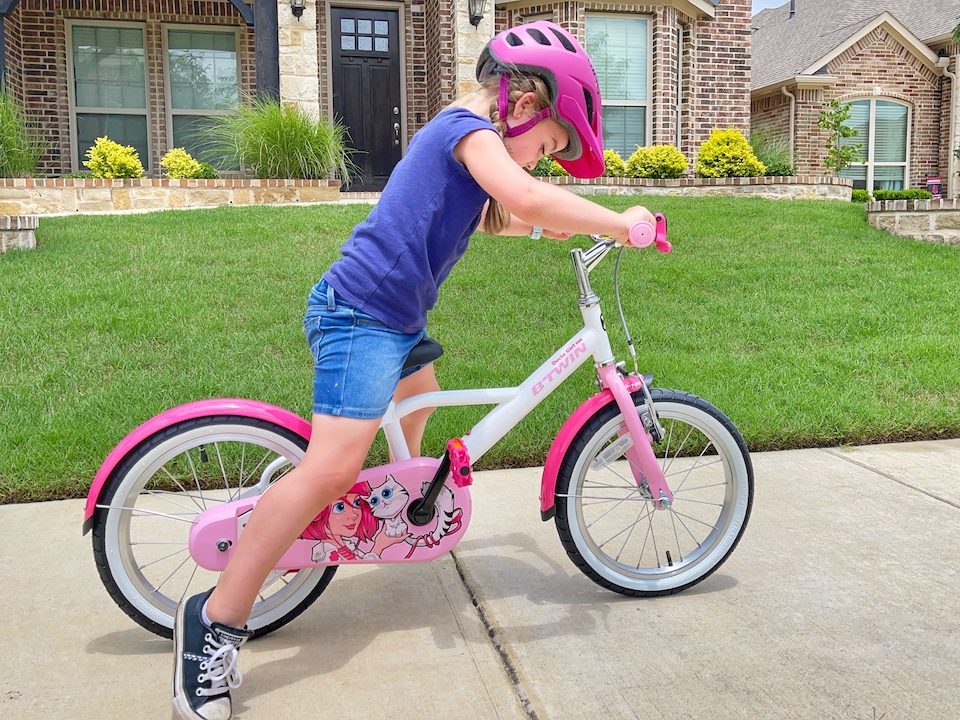
As time moves on and your brave 3-year-old masters pedaling, the seat height can be raised so that they are only touching the ground with their tiptoes. This allows for better leg extension while pedaling.
Geometry – A Common Problem with 12 Inch Bikes
The geometry of a bike refers to how the child is positioned on the bike. From frame design to handlebar shape, the geometry of a bike plays a huge role in how comfortable and easy it is to ride.
Unfortunately, due to the small size of 12 and 14 inch wheels, it can be very challenging for small bikes to have great geometry, especially on 12 inch bikes.
Small Wheels Lead to Cramped Pedal Stroke
The biggest problem lies in the fact that the center axle of 12 inch wheels are much closer to the ground than on larger 14 inch wheels. To make room for the crank arms and pedals on 12 inch bikes, the bottom bracket (where the crank arm attaches to the frame), has to be moved up on the bike.
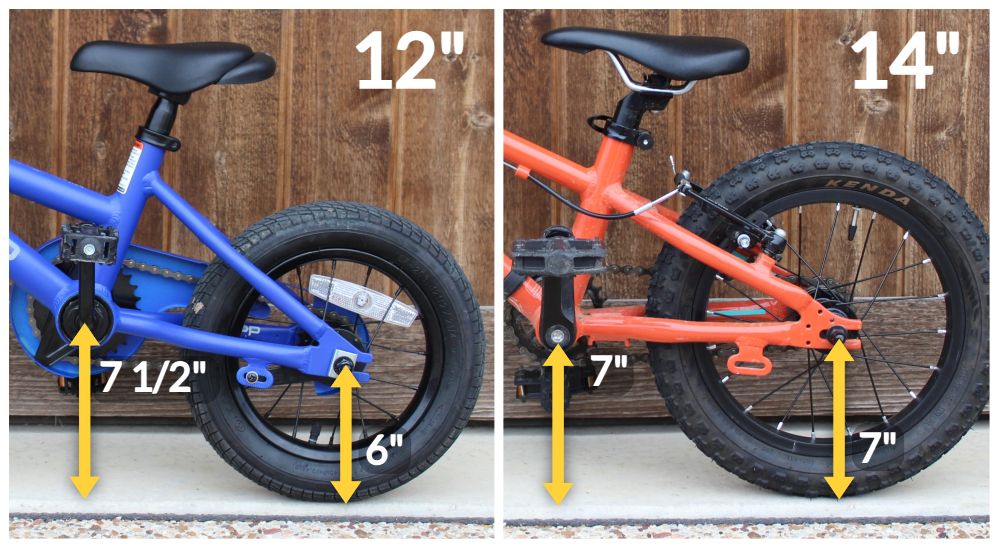
While this makes room for the pedals on the downswing, you lose over an inch of space on the upswing, creating a cramped leg position. With less space for the upswing, the child’s knees are at a much sharper and much less efficient angle to apply maximum force on the downswing (as shown on the blue bike below).
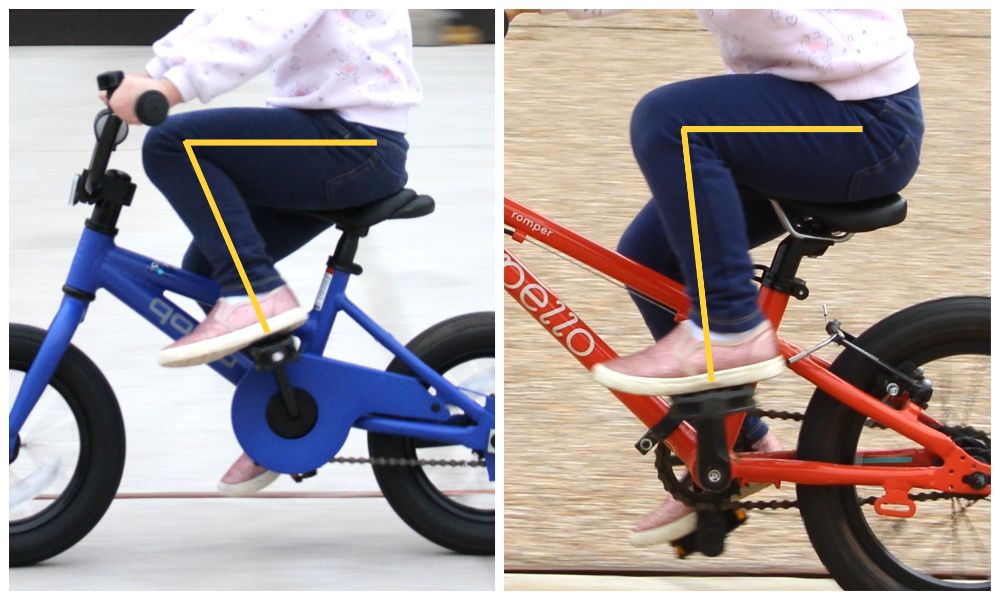
Moving up to 14 inch wheels makes a huge difference. As you can see above on the 14″ orange bike, the extra inch of space for the crank arms and bottom bracket allows for more space at the high stroke. The child’s knee is much less forward on the bike, making the downward pedal stroke significantly less angled and therefore much more efficient.
As a result, this is why almost all child-specific bike brands offer 14″ bikes versus 12″ bikes.
Higher Minimum Seat Height is Too Tall
To compensate for higher pedals on the upstroke, bike manufacturers often raise the minimum seat height of a 12″ bike, but that only causes more issues.
With a high minimum seat height, kids are often perched really high on top of the frame, which creates a high center of gravity on the bike and makes it harder to balance at lower speeds.
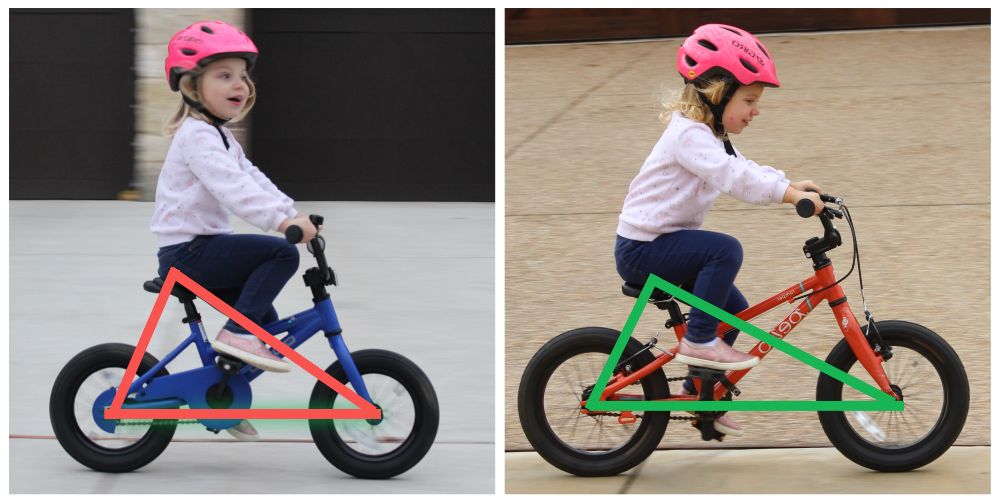
They also usually can’t touch the ground when sitting on the saddle, or if they can, it’s only with their tip toes. New riders need feet flat on the ground for confidence and safety.
Short Wheelbases Create a Cramped Ride
12 inch bikes also suffer from short wheelbases (the distance between the axles of the bike’s wheels). This causes kids to be scrunched on the bike, with little room between the handlebars and the seat.
Cockpit of Cheap 12″ vs. Well-Designed 14″ Bike
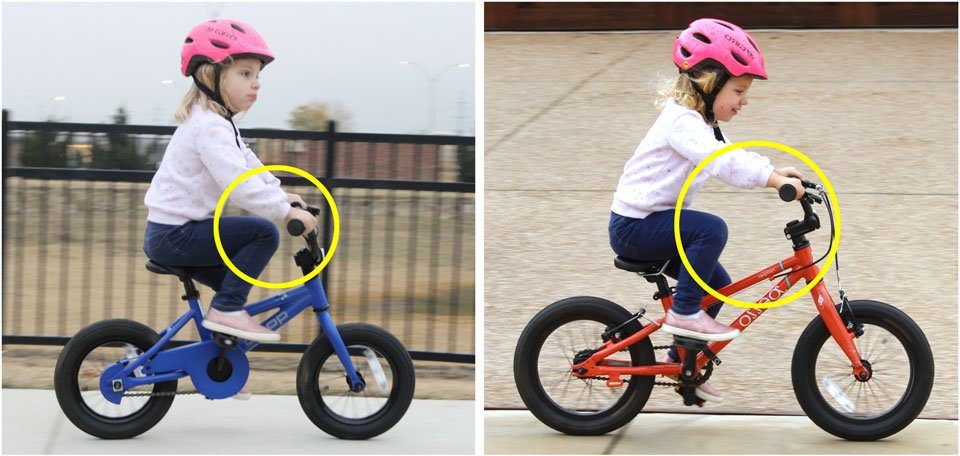
Short wheelbases negatively affect kids riding with or without training wheels in several ways.
- It prevents a child from being able to properly shift their weight around during a turn or even just to help them maintain balance.
- With the child sitting upright they are often not able to lean forward very much. As a result, there is less weight on the front tire, which makes the bike less stable and much more “squirrelly” when riding. This is especially problematic on bikes with lower-set handlebars like the blue bike shown above.
- On some bikes, turning can be a challenge as the handlebars can hit the child’s knees when turning.
The properly-designed 14 inch bikes we do recommend have longer wheelbases which provide more space for the child rider. This increases stability and maneuverability and makes the bikes easier to ride.
Weight – Lighter is better
Ideally, your child’s bike shouldn’t weigh more than 40% of their body weight. Learning to pedal and balance at the same time can be challenging, but even more so if your child has to work extra hard to keep a heavy bike upright. Getting up from a fall is also far more discouraging when your bike weighs a ton!
For example, the Royal Baby 14″ bike weighs 21.7 lbs, while the woom 2 (14 inch) only weighs 12.3 lbs. That’s almost TEN extra pounds of bike! Which bike do you think will be easier for your 3-year-old to maneuver?
Brakes – Try to avoid coaster brakes
Coaster brakes (back pedal brakes) are required by CPSC standards on almost all kids 12 inch and 14 inch bikes in the US, but they can make it much more difficult to learn to pedal while balancing a bike.
Because a child naturally pedals backward (especially when learning to pedal), coaster brakes become problematic as they cause kids to brake accidentally, which can lead to falls and lost motivation. Even once they have mastered balancing, preventing the child’s natural inclination to pedal backward to regain balance puts the child at a disadvantage.
If a child is coordinated enough to be riding a bike without training wheels, they are most likely also coordinated enough to use a hand brake. Also, keep in mind that the hand brakes on higher-end kids’ bikes today are significantly easier to use than the hand brakes you had on your bike as a kid. The brake levers on these bikes are easy for small hands to reach and require minimal effort for them to pull.
Due to CPSC regulations, many higher-end 14 inch bikes are still sold with a coaster brake, but these companies also offer an optional “freewheel kit” that allows you to swap out the back wheel and remove the coaster brake on your own. These bikes are then coaster-brake-free and rely on much better handbrake system to stop the bike.
Using Training Wheels with Small Bikes
While we can attest to the benefits of balance bikes over training wheels, we understand that sometimes families prefer to use training wheels. If you do decide to use training wheels, be sure to buy a bike that has stable and secure training wheels.

Also, once your child is ready to take the training wheel off, try using their bike as a balance bike to help ease the transition. To do so, remove the training wheels and pedals and have the child practice running while seated on the bike.
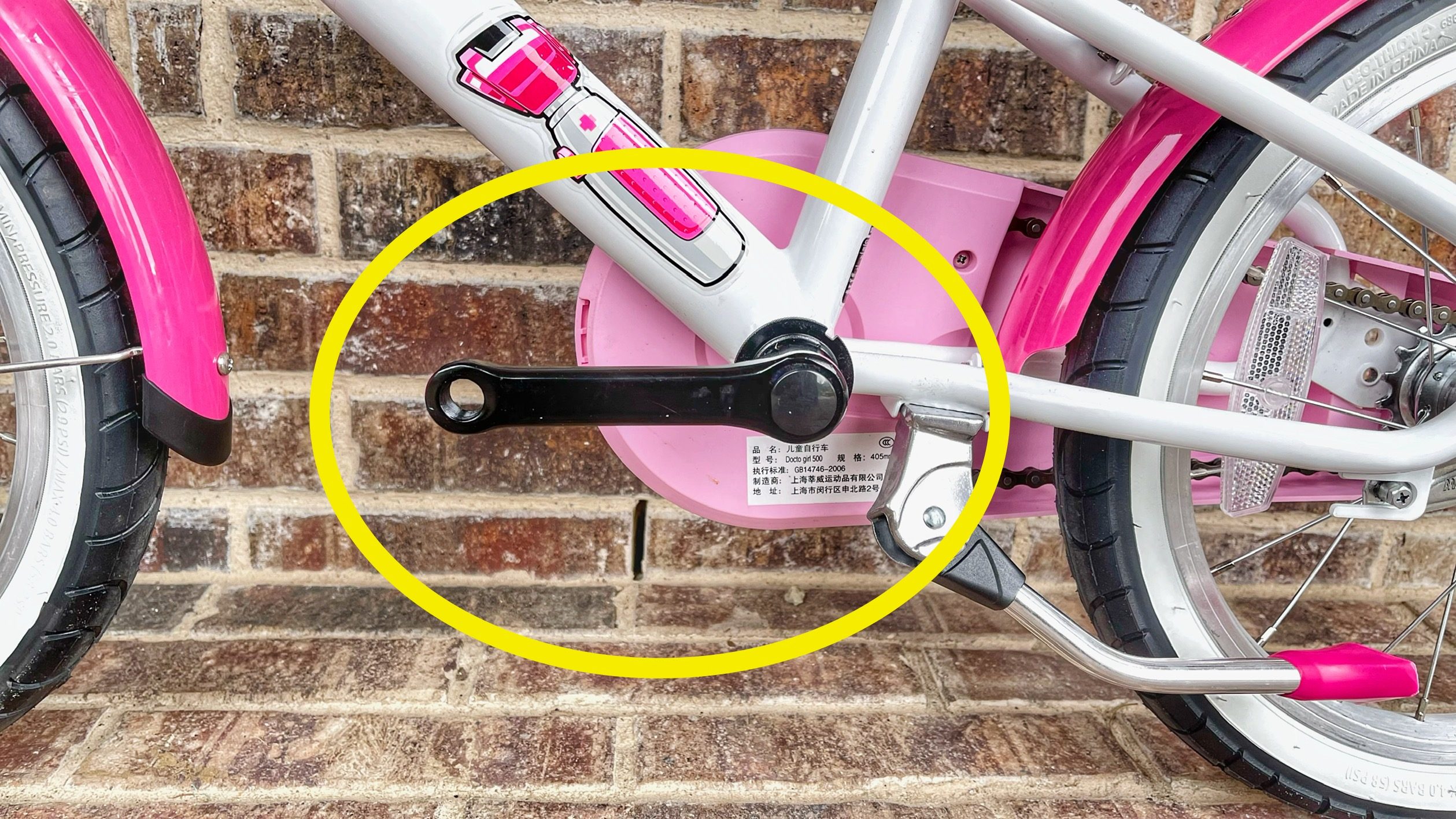
Once they can run and glide on the bike, put the pedals back on and add pedaling at the third step. First run on the bike, then glide, and lastly start pedaling. For a more thorough explanation of how this works, read our article How To Teach a Kid to Ride a Bike the Easy Way.
Why trust us?
We have thoroughly tested every bicycle on this list and have a garage storage problem to prove it! Unlike other websites, we don’t just build lists, we actually test each product with our own kids. With 15 years of bike testing under our belt, we’ve personally met and consulted with many top brands in the industry including woom, Guardian, Strider and Prevelo.
Related Kids Bikes Articles
10 Best Girl Bikes: Looking for a high-performance bike in pink, purple, or cute designs? Check out our list!
Training Wheels: 10 Frequently Asked Questions: Training wheels make learning to ride a bike harder. Find out why!