Biky Air 14 Inch Bike Review – The Best 14” Bike
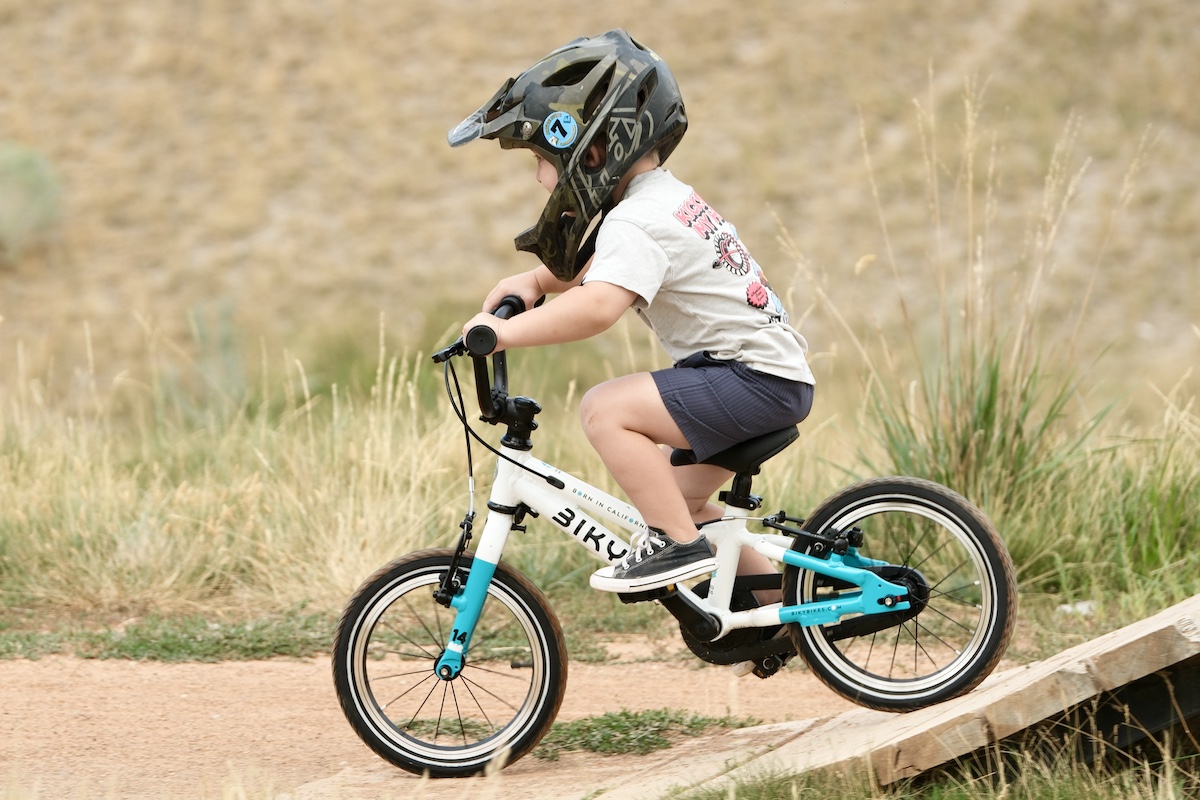
When it comes to getting your little one rolling happily on two wheels, the Biky Air 14-inch bike checks all the right boxes. It’s lightweight, coaster-brake-free, and offers plenty room for growth. It’s truly a standout choice.
As a newcomer to the bike world, we put the Biky Air to the test against several competitors to see how it stacked up. In our tests with multiple riders of various ages and heights, the Biky performed like a seasoned champ. From crank arm length to wheelbase, we’re here to share our real-world experiences with how every feature affects riding ease and performance.
Biky Air 14
OUR SCORE: 97.5/100 – Exceptional
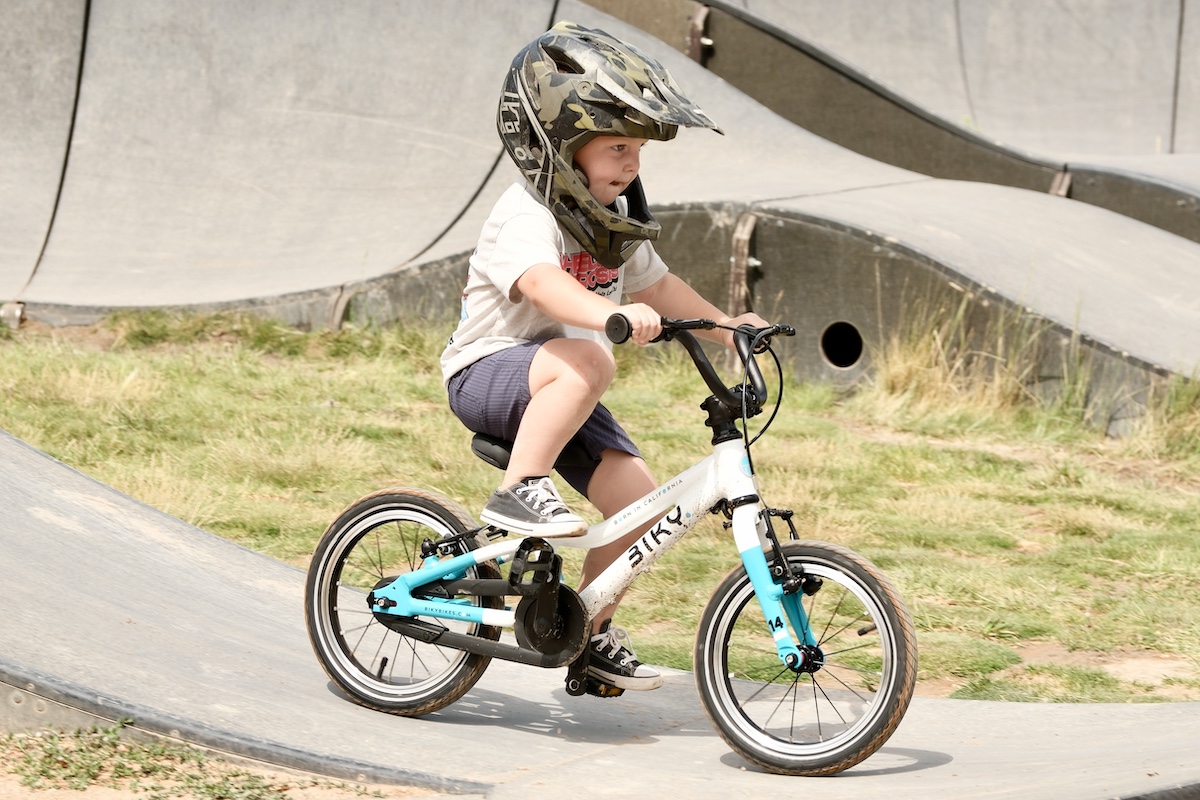
MSRP: $399
BEST FOR: Any young rider advancing from a balance bike, and especially those who are hesitant or timid.
SEAT HEIGHT: 17″ to 22″ (requires cutting second seat post to get past 19″)
WEIGHT: 11.95 lb. (on our scale)
ADDITIONAL SPECIFICATIONS
BRAKES: Dual hand brakes (no coaster)
FRAME: Aluminum Alloy
GAIN RATIO: 3.57
TRAINING WHEELS: Not compatible
Cons:
Our 14 Inch Bike Rubric Score
We score each 14″ bike on a 103-point scale (100 base + 3 extra credit) across seven categories. Most criteria are checkboxes—the bike either has the feature or doesn’t. Weight and Useable Fit Range are scored proportionally by comparing all bikes in our dataset. See how other 12″/14″ bikes scored on our Best 14″ Bikes page.
The Biky scored highest in our dataset due to its exceptional light weight and wide fit range. Note: the Biky’s weight excludes its kickstand (sold separately), while competitors like woom and Guardian include theirs. The Biky’s extended seat post requires cutting to access the full seat height range—most bike shops will do this for minimal cost.
How the Biky Air 14 Scored
Score Breakdown ▼
Weight 20.0 / 20 ▼
How it’s scored: Weight score is calculated proportionally, with the lightest bike in the comparison set receiving 20 points and the heaviest receiving 0 points.
Bike Weight: 11.95 lbs (lightest in class)
Frame Design 20 / 20 ▼
What we evaluate: Evaluates the bike’s structural foundation and geometry. Points are awarded for features that reduce weight, lower the center of gravity, improve stability, and make the bike easier for young riders to mount and control.
- ✅ Aluminum Frame (4 pts)
- ✅ Low Bottom Bracket (3 pts)
- ✅ Low Min Seat Height < 17" (3 pts)
- ✅ Confidence Building Geometry (3 pts)
- ✅ Low Step-Through Frame (3 pts)
- ✅ 14″ Wheels vs 12″ Wheels (2 pts)
- ✅ Threaded Bottom Bracket (2 pts)
Components 19 / 20 ▼
What we evaluate: Assesses the quality and appropriateness of parts that directly affect ride quality and durability. Gain ratio (3.5–4.0) and crank arm length (81-90mm = 4pts, 75-80mm = 3pts, 70-74mm = 2pts) are scored based on optimal ranges for 14″ bikes.
- ✅ Crank Arm Length 85mm (4 pts)
- ✅ Narrow Q-factor (3 pts)
- ✅ Gain Ratio 3.5-4.0 (2 pts)
- ✅ Quality Seat Post Quick Release (2 pts)
- ✅ Adjustable Handlebar (2 pts)
- ✅ Sealed/Cartridge Bottom Bracket (2 pts)
- ✅ Rattle-free Chain Guard (1 pt)
- ❌ Kickstand Included (1 pt)
- ✅ Grips with Protective Bumper End (1 pt)
- ✅Schrader-Compatible Rim (1 pt)
- ✅ Comfortable Padded Saddle (1 pt)
Brakes 20 / 20 ▼
What we evaluate: Focuses on stopping power and safety. Prioritizes hand brakes over coaster brakes, rewards features that make brakes easier for small hands to operate, and values brake system redundancy.
- ✅ No Coaster Brake OR Removable Option (4 pts)
- ✅ Short Reach Brake Levers (4 pts)
- ✅ V-Brakes (4 pts)
- ✅ Easy Pull Levers (3 pts)
- ✅ Alloy Brake Levers (2 pts)
- ✅ Brake Duplicity (2 pts)
- ✅ Tool-Free Adjustable Reach Levers (1 pt)
Useable Fit Range 9.5 / 10 ▼
How it’s scored: Bikes with wider useable seat height ranges score higher on a proportional scale, where the widest range scores 10 points and the narrowest scores 0 points. Useable range is calculated as the lesser of (handlebar height – 2.5″) or max seat height, minus minimum seat height.
Useable Range: 6.0″
Ease of Assembly 5 / 6 ▼
What we evaluate: Measures how parent-friendly the out-of-box setup is. Points are given for clear instructions, minimal assembly requirements, and pre-tuned brakes.
- ✅ Clear Written Instructions (2 pts)
- ❌ Video Instructions (1 pts)
- ✅ Easy Assembly (1 pt)
- ✅ Pre-tuned Brakes (2 pt)
Customer Service 3 / 4 ▼
What we evaluate: Evaluates the manufacturer’s post-purchase support. Bikes earn points for responsive customer service, frame warranties, and component coverage.
- ✅ Customer Service with Real Person (2 pts)
- ✅ Frame Warranty (1 pt)
- ❌ Partial Component Warranty (1 pt)
Extra Credit +1 ▼
What earns extra credit: Bonus points for innovative features that enhance versatility or usability beyond standard expectations.
- ✅ Easily Converts to Balance Bike (+1 pt)
- ❌ Tool-Free Training Wheel Compatibility (+1 pt)
- ❌ Color Coded Levers/Cables (+1 pt)
- ❌ Rear Placed Kickstand (+1 pt)
Who is Biky Bikes?
First off, who is Biky Bikes? Founded in 2023, Biky Bikes is a new bicycle brand based in Covina, California. But the team behind Biky Bikes brings years of experience in the children’s bike industry in Eastern Europe to the US market.

Since their inception, Biky Bikes has already won several awards for design, including the iF Design Award (a version of this balance bike is in the works!) and the NY Design Awards.
Biky Bikes specializes only in kids bikes and currently offers a 12″ balance bike as well as 14″, 16″ and 20″ pedal bikes.
Biky Air 14 Review – Results of our Test Rides
NOTE: This review includes images of both the older Biky Air 14 (red and white bike) and the updated model (blue and white bike). While there are a few minor differences between the two versions, the most notable change is that the latest model now comes equipped with dual hand brakes, whereas the earlier version (shown in red and white) features only a single hand brake.
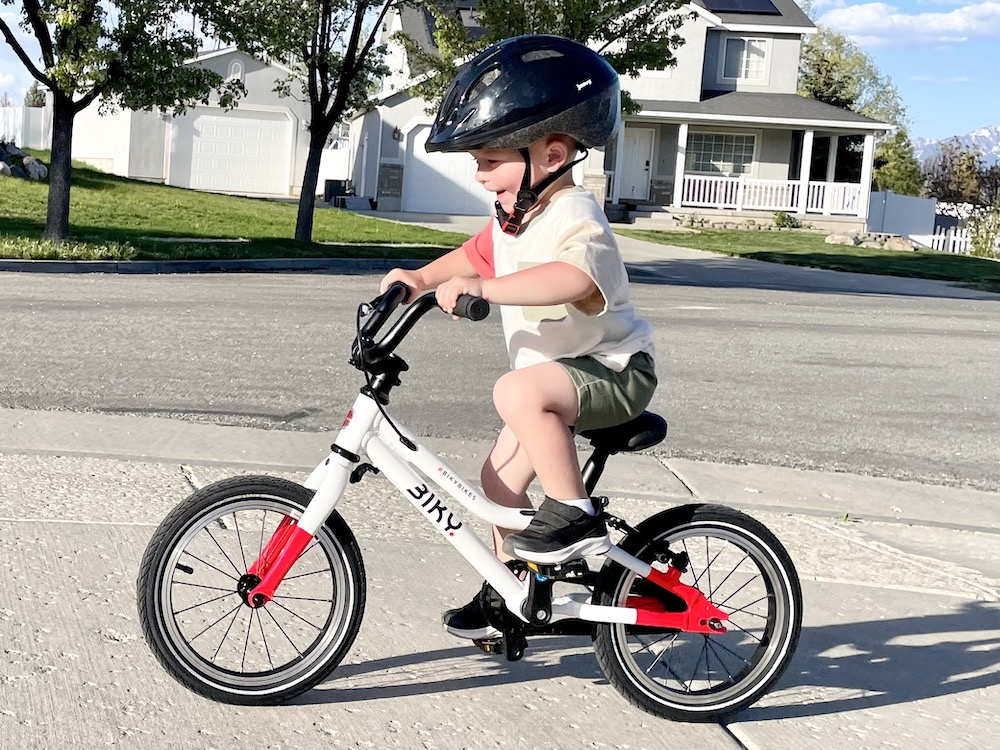
It’s a rare occasion when a new 12″ or 14″ bike hits the market and impresses us, but the Biky has certainly managed to do just that. Crafting a high-quality 12″ or 14″ kids’ bike is no easy feat due to their small size, yet Biky has excelled in its first attempt.
Not only is it lighter than other bikes in its category, but it also offers plenty of room for growth and comes equipped with a freewheel instead of a coaster brake.
While the Biky sure looks good on paper, our group of young testers, ages 3 to 5, confirmed it during our testing period. Once the “new bike” excitement wore off, we knew Biky was on to something when our testers clearly preferred the Biky over several of our tried-and-true 14″ bike favorites.
What Size and Age of Child Fits on the Biky Air 14?
During our multiple testing sessions, we put the Biky Air 14 head-to-head with other popular 14″ pedal bikes, including the Guardian 14″ and the woom 2. Our test riders included a 3, 4, and 5-year-old, all of whom were proficient riders without training wheels.
The Biky Air 14 fits children with inseams ranging from 17” to about 21”, making it a great option for young riders wearing roughly 2T to 5T pants. However, seat height range on the Biky depends on which of the two included seat posts you use—and whether you’re willing to make a small modification.
- The main (shorter) seat post offers a seat height range of 17” to 19”. This range worked well for our 3- and 4-year-old testers.
- The second (longer) seat post provides a seat height range of 22” to 25”, but it cannot be lowered further due to interference from the bike’s bottom bracket.
- However, by cutting 3” off the longer post, you can achieve a usable seat height range of 19” to 22”. This effectively bridges the gap between the two seat posts and takes full advantage of the frame’s geometry.
So while the standard range is 17” to 19” or 22” to 25”, with a simple cut to the second post, the Biky 14 offers a much more flexible seat height range of 17” to 22”.
Seat Height
During our multiple testing sessions, we put the Biky Air 14 to work alongside the Guardian 14″ and the woom 2 (14″). Our testers included a 3, 4, and 5-year-old—all confident riders without training wheels.
The latest version of the Biky has a minimum seat height of 17”, up from 15.5” on the previous model. While that may sound like a drawback, it’s actually a good move—most kids with a 15.5” inseam aren’t quite ready for a pedal bike anyway. The increase allows for more growth, as the maximum seat height also jumped from 18” to 19”.
For taller riders, the included second seat post (which is longer) can be trimmed to push the max seat height even further—up to 21.5”. This makes the Biky 14 suitable for kids with inseams ranging from 16.5″ to about 21″, which typically corresponds to kids in 2T to 5T pants.
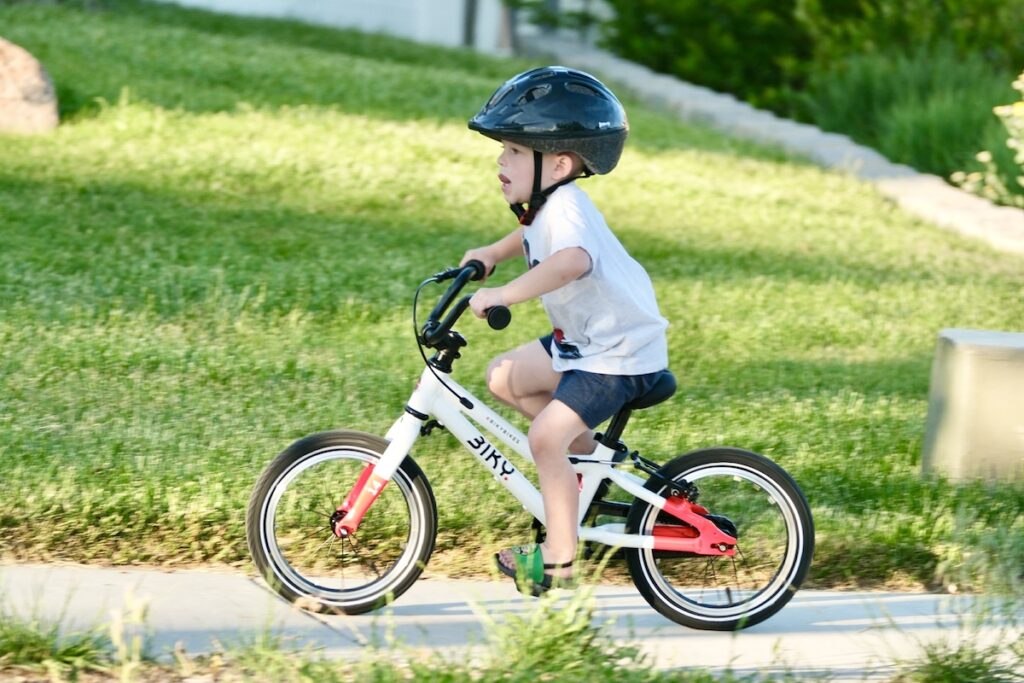
Taller kids needing a seat height above 19” must use the longer seat post. However, this post is very long and bottoms out on the bike’s bottom bracket (due to outdated CPSC regulations about coaster brakes), so it can’t be used below 22” without modification. A quick and inexpensive fix is to cut a few inches off the post, which any bike shop should be able to do.
Is the bike rideable at those higher ranges? Absolutely. Our 42″ tall 5-year-old tester rode with the seat set at 21” and had a great fit. The extra range makes the Biky 14 a solid choice not just for early pedalers, but for kids who are ready to keep progressing—without quickly outgrowing their bike.
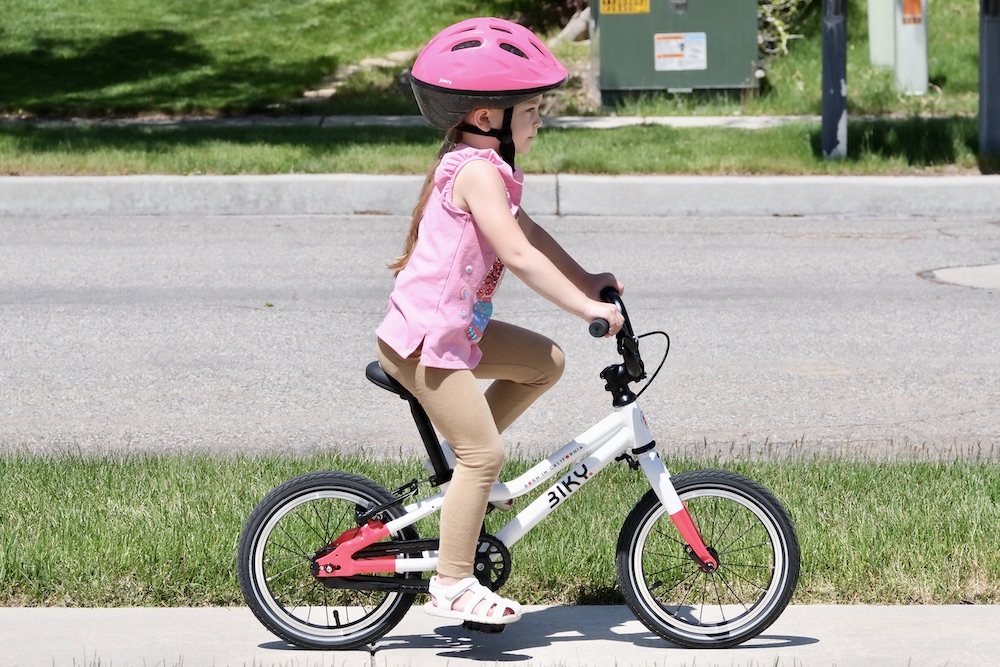
While the bike is certainly on the smaller side, she still enjoyed riding the bike without feeling too cramped.
With the minimum seat height of a few 20″ bikes coming in at around 21″ or 22″, it’s possible to skip from the Biky 14″ to a 20″ bike. That said, we actually wouldn’t recommend it, as its a big jump in wheel size.
Biky 14 vs. Biky 16
If your child’s inseam already measures 17.5″, you might want to consider the Biky Air 16, with a seat range of 19″ – 25″. This slightly larger bike offers more growing room without being too big for little ones to maneuver.
Compared to other 16″ bikes, the Biky 16 is small; the minimum seat height of the woom 3 is almost an inch taller at 19.3″ while the Commencal Ramones is over 2″ taller at 20.8″.’
While small, it is certainly a step up in size compared to the Biky 14″. In the image below, our 5-year-old tester is riding both the Biky 14 and 16 with the seat height set to 21″.
42″ Tall Rider on Biky 14 vs. Biky 16

What We Love about the Biky Air 14
Lightweight Built
Built with a lightweight aluminum frame and with smaller kid-specific components, the Biky 14″ comes in at 11.95 lb. on our hanging bike scale. With the average 3-year-old weighing in at 26 lb. to 38 lb., most 12″ and 14″ bikes are over half their body weight!
While many young riders can make heavier bikes work, lightweight bikes are even more important for timid or petite riders. Since young riders often ride for shorter periods, having to frequently pick up a heavy bike to turn it around or reposition it can be discouraging, especially for those who are already apprehensive.
How Does the Weight of the Biky Compare to Other Bikes?
At 11.95 lb., the Biky Air 14 is right in line with other premium 14” bikes—offering easy handling, better control, and a smoother transition from a balance bike.
- The woom GO 2 weighs just a touch more at 12.2 lb., likely due to its built-in kickstand, which the Biky does not include. Both are among the lightest in their class and ideal for younger riders who benefit from a nimble, responsive ride.
- In contrast, the Guardian 14 comes in much heavier at 16.5 lb. While it’s a solid and more budget-friendly option, the added weight can be a hurdle for smaller or less confident riders—particularly when starting, stopping, or navigating tight spaces.
No Coaster Brake!
The Biky 14 comes standard without a coaster brake. Having tested kids’ bikes for 15 years, I can assure you that teaching a child to ride a bike is significantly easier on bikes that do not have coaster brakes.
When learning to pedal, kids often pedal backward by mistake, inadvertently engaging the coaster brake, which can lead to a crash. Even if the child doesn’t fall, the sudden activation of the coaster brake can kill their momentum, which can be frustrating.
Without a coaster brake, upon pedaling backwards, the bike will continue moving forward without losing momentum. Within a few seconds, the child can correct their pedal stroke and continue riding.
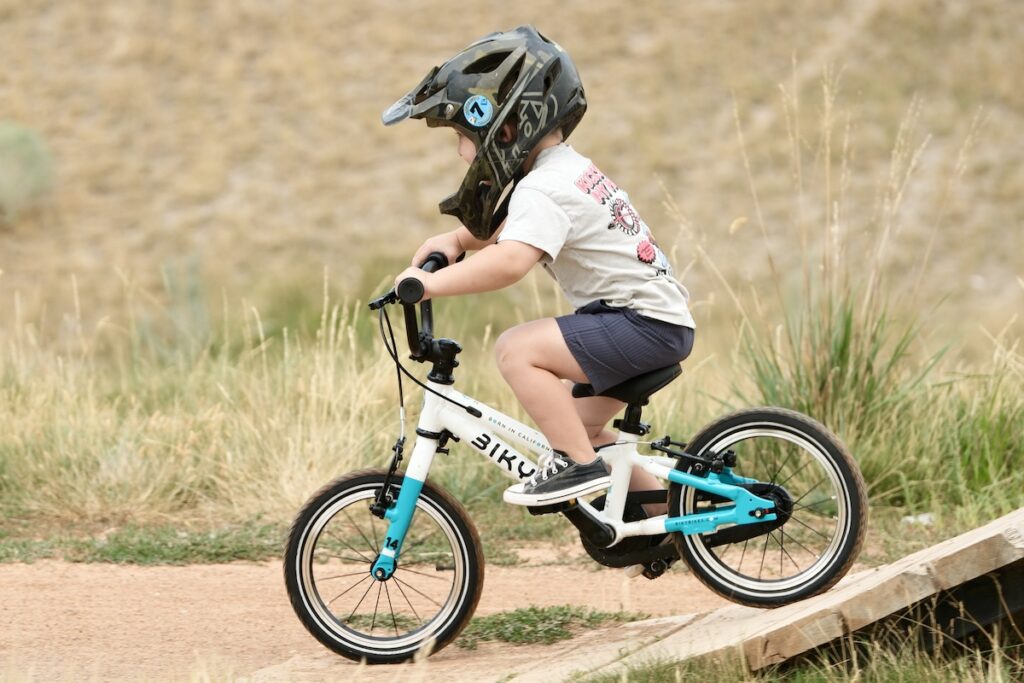
Although most higher-end bikes offer freewheel kits to remove the coaster brake, these kits add to the cost of the bike and can be challenging to install.
Why don’t all brands include a freewheel kit? Unfortunately, this is due to CPSC regulations (the same reason the second seat post has to be so long). Biky (as well as Guardian) avoids the coaster brake requirement by including the longer seat post with their 14″ bikes. Woom offers a freewheel kit and stock their bikes with seat posts of reasonable heights.
Longer Wheelbase and Cockpit
While it’s hard for our young riders to articulate what they love about a bike, after watching repeated test rides, it was easy to see that the Biky was bigger than other 14″ bikes – not in height, but in length. The wheelbase of the Biky 14 is just under 1.5″ longer than the woom 2 and Guardian 14.
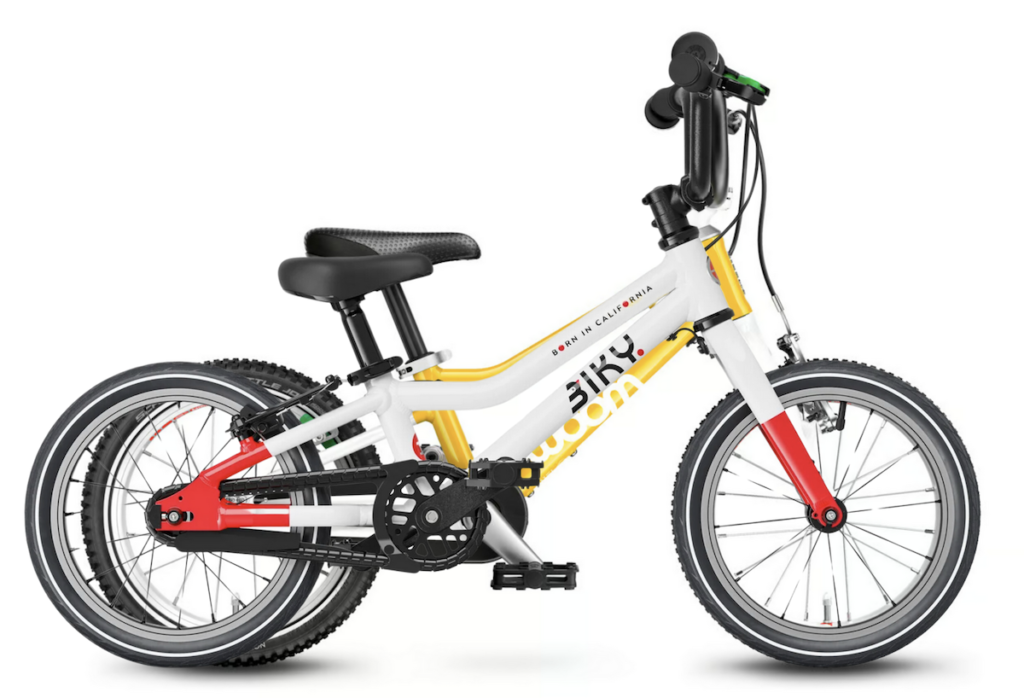
While most of the added wheelbase is in the chainstays (the frame tubing that runs parallel to the chain), the saddle of the Biky 14 is also positioned farther back on the bike than the woom 2. This additional space provides for more space in the cockpit (distance between the child’s body and the handlebars).
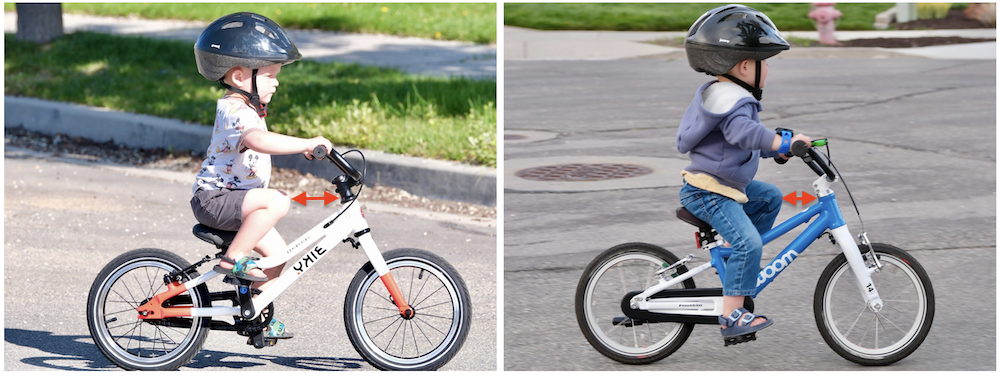
More space in the cockpit allows for more space for growth, more maneuverability (especially as kids get more aggressive and want to lean in), and can prevent young riders’ knees from hitting the handlebars during sharp turns.
For a slightly taller 3-year-old tester with the seat height to 18″, the difference is even more apparent with the 12″ Cleary Gecko (discontinued).
Biky 14 vs. Cleary Gecko 12
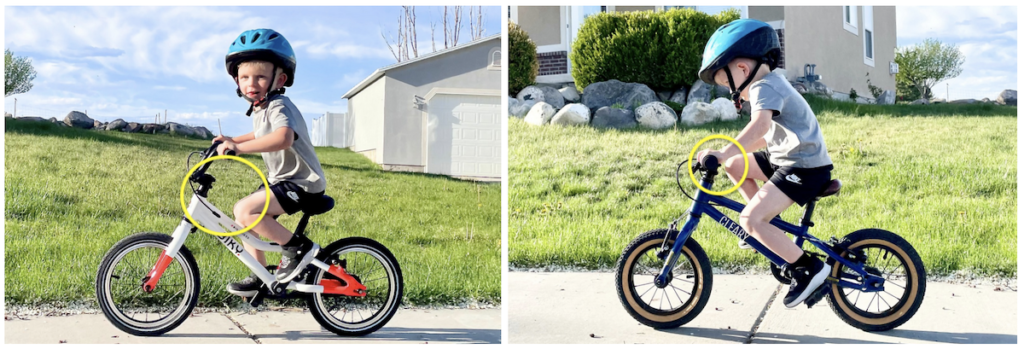
Too large of a cockpit can be problematic (riders have to lean too far forward to reach the handlebars), so Biky ensured their handlebars could be tilted inward for smaller riders.
This allows a small rider to reach the grips without having to sacrifice their natural, upright body positioning. woom’s handlebars also tilt in, but their taller bars can quickly impede the cockpit.
Wider Base for Taller Riders
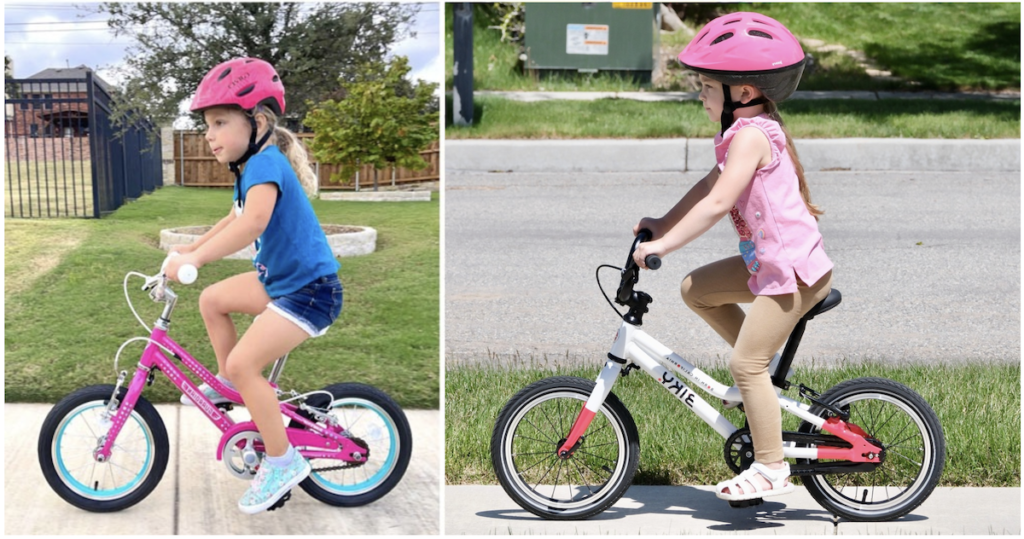
One of the biggest benefits of the longer wheelbase is that it provides additional space for taller riders. A longer wheelbase allows for a larger cockpit, but also creates a wider base, helping taller riders feel more balanced and centered on the bike.
The two different riders below are both riding at a 21″ seat height. Biky’s longer wheelbase (longer than Guardian’s by 35mm) provides a wider base than the Guardian.
Guardian 14 vs. Biky 14 with Taller Riders
Longer Crank Arms
The crank arms of a bike are the metal pieces that connect the pedals to the bike. They vary in length depending on the bike brand. The Biky 14 features longer crank arms compared to other 14″ bikes, measuring 19mm longer than the Guardian 14!
With the crank arm essentially being the radius of the pedal circle, the longer the radius, the larger the circle. While long crank arms do have their downside, on a positive note, they prevented kids from having to pedal in super fast and tight circles!
Over the years, we have seen our fair share of little riders struggle to pedal bikes with tiny crank arms due to the small pedaling motion required. The super short crank arms on the Guardian 14 have been problematic for some of our test riders.
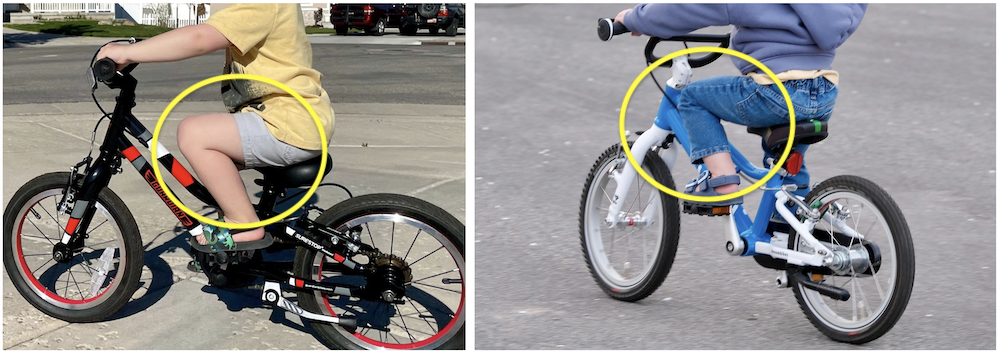
With the longer crank arms of the Biky, the downside is that they create a more cramped pedal position on the high stroke for kids riding at lower seat heights. When set to the minimum seat height of 15.5″, there is only 5″ of space between the top of the pedal stroke and the bottom of the seat, which leads to a tight knee bed on the upstroke.
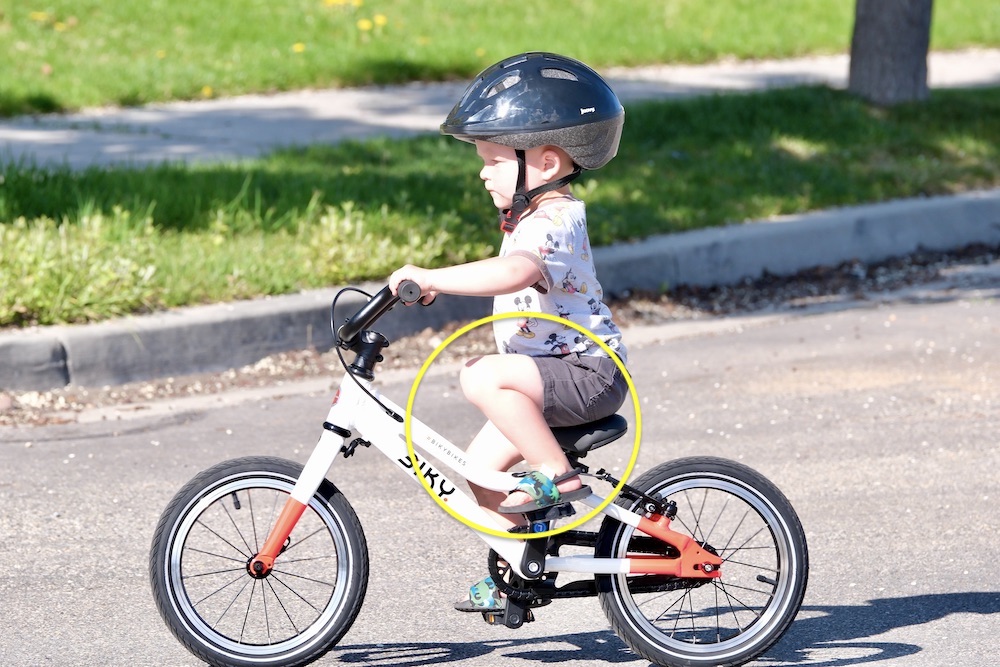
As a comparison, when set to their minimum seat height of 16″, the woom 2 offers 5.5″ of space and the Guardian 6.2″. However, if we raise the Biky’s minimum seat height 0.5″ to match the others at 16″, then it’s on par with the woom at 5.5″ of space. So although the Biky’s is slightly tighter, we didn’t find it to be more problematic than the others.
Gain Ratio
The gain ratio of a bike helps describe how easy or hard it feels to pedal by factoring in both the gearing and crank length. A higher gain ratio generally means the bike feels harder to pedal, while a lower gain ratio feels easier.
Compared to the woom and Guardian bikes, the Biky 14 has the lowest gain ratio at 3.57, with woom at 4.0 and Guardian at 3.95. This means the Biky should feel the easiest to pedal of the three.
When it comes to pedaling speed, cadence (aka pedal speed) is determined by the bike’s gearing and wheel size. This is especially important on 12” and 14” bikes, which are often geared in a way that forces kids to pedal at very high, and sometimes uncomfortable, cadences. The Guardian has lower gearing than the other two bikes, so it travels less distance with each pedal stroke and requires a faster cadence to keep up.
To put that into numbers, to ride at 10 mph, a rider would need to spin about 154 RPM on the Guardian, compared to about 134 RPM on the woom and Biky 14. That’s a noticeable difference, and one that many kids will feel.
The shorter 70 mm cranks on the Guardian don’t directly increase cadence, but they do reduce leverage. Compared to the Guardian, the longer cranks on the Biky (89 mm) and woom (80 mm) provide more leverage, which can make them feel easier to pedal and a bit more controlled, especially for newer riders.
Handlebar Design
Smaller riders need narrower handlebars, but how narrow? Young riders also prefer taller handlebars to allow then to sit more upright, but how tall?
Over the years we’ve seen a huge range of handlebar heights and widths, and while there certainly isn’t a perfect, one-size-fits all bar for young riders, the Biky 14’s comes pretty close.
From inside grip to inside grip, the Biky 14’s bar is 1″ narrower than the woom 2’s. As shown in the images below, you can see how our young rider doesn’t have to splay his arms out quite as wide on the Biky.
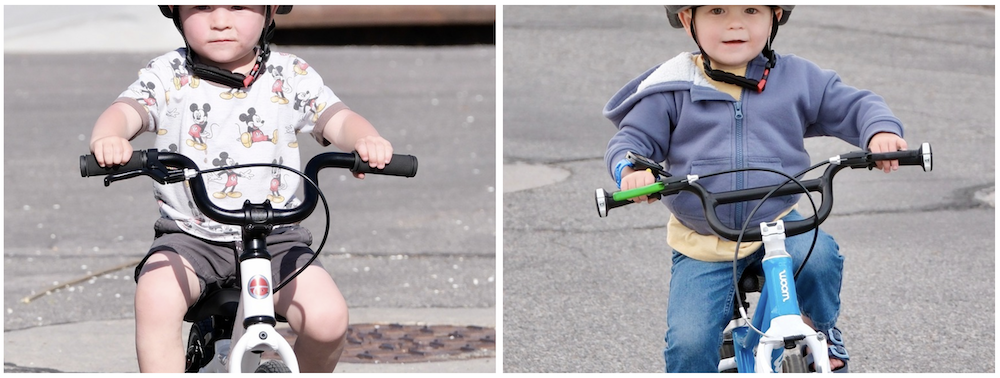
As the child grows, there is still plenty of room on the bar for when they need to widen their grip.
The newest Biky update makes it easier to correctly position the handlebars. Four small alignment marks on the handlebar show through the stem, letting you know when the bars are centered and upright.
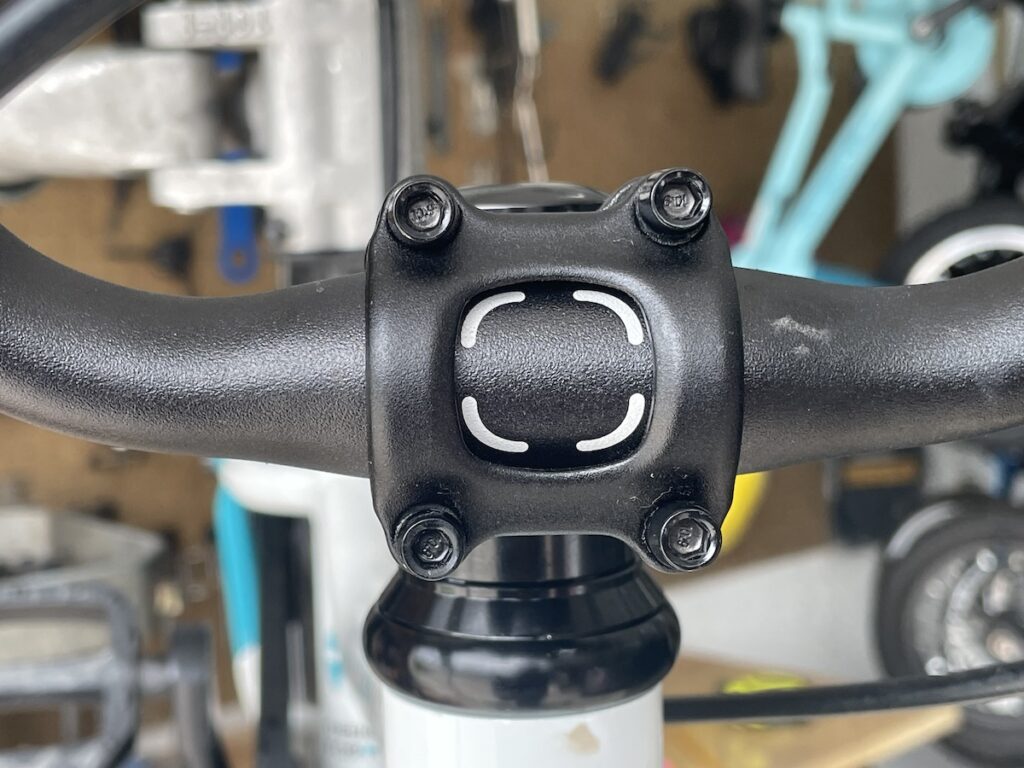
If your child is riding with the saddle set at the lowest height, you can slightly rotate the handlebars inward for a closer reach. As they grow, those same markings help you rotate the bars back to a fully centered position so the fit stays comfortable.
Protective Grip
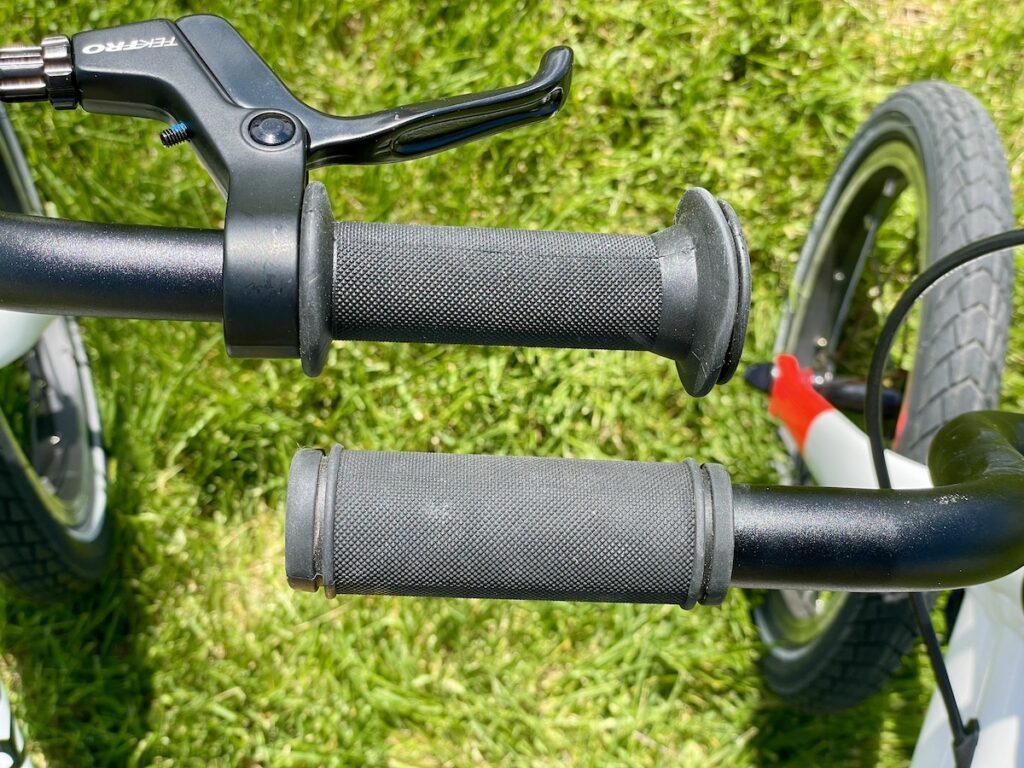
To help protect little hands in the event of a fall, the latest Biky models now feature a protective bumper at the end of each grip. This bumper helps prevent the side of a child’s hand from making contact with the ground, offering an added layer of safety when spills happen.
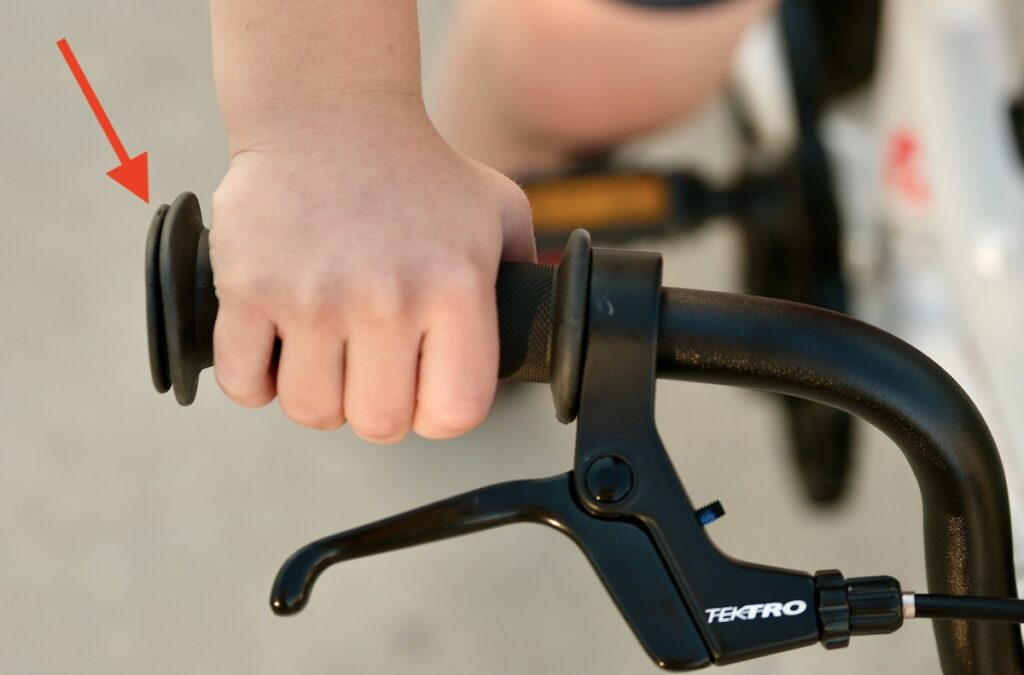
The grips themselves are also smaller in diameter, making them easier for young riders to hold on to securely. In the image below you can see just how much narrower the new grip (on the top) is compared to the older grip.
Enclosed Chain Guard
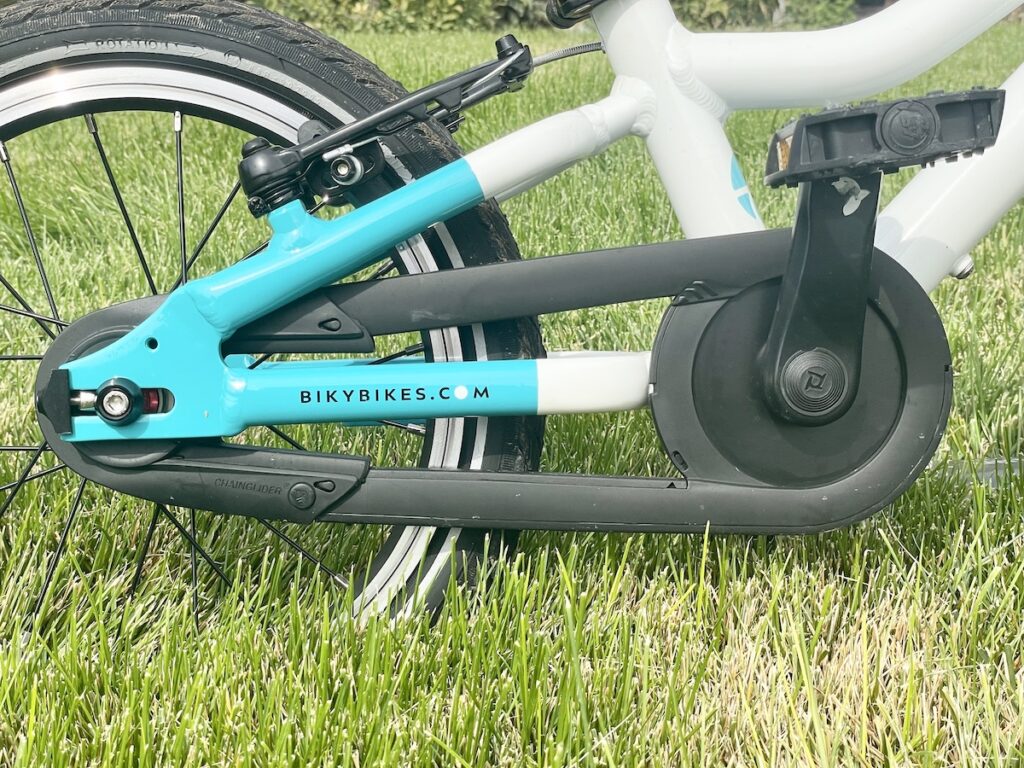
All small kids’ bikes are required to have a chain guard and most are pretty clunky. The Biky 14 stands out with its fully enclosed chainguard, which prevents any fingers or clothes from coming into contact with the chain.
Removable Turning Limiter
The Biky has the same turning limiter as most higher-end 12″ or 14″ bikes on the market. The design is simple and effective in preventing the brake cable from being wrapped around the headset.
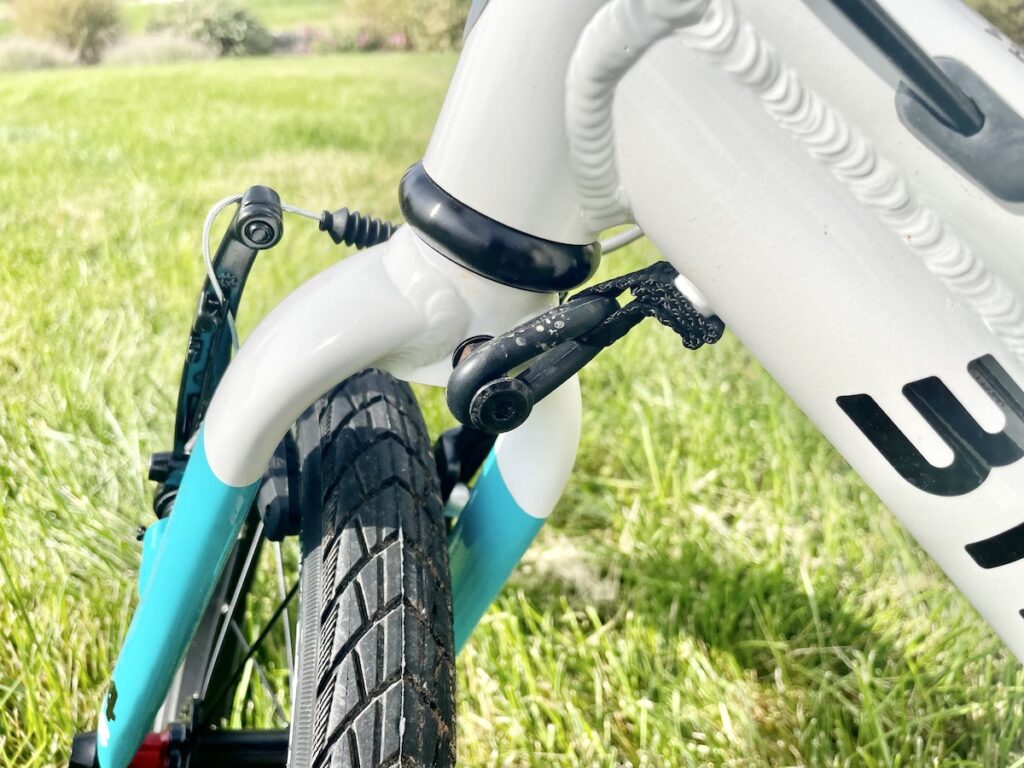
The turning limiter is also removable, but we wouldn’t recommend it as it doesn’t restrict a child’s steering enough to need to be taken off, and it protects the brake cable from accidentally getting stretched out.
Street Tires vs. All-terrain
The Biky comes equipped with smoother, street tires. While this makes sense for the majority of riders who stick to pavement, a multi-use tire option would benefit the few kids who venture onto dirt paths.
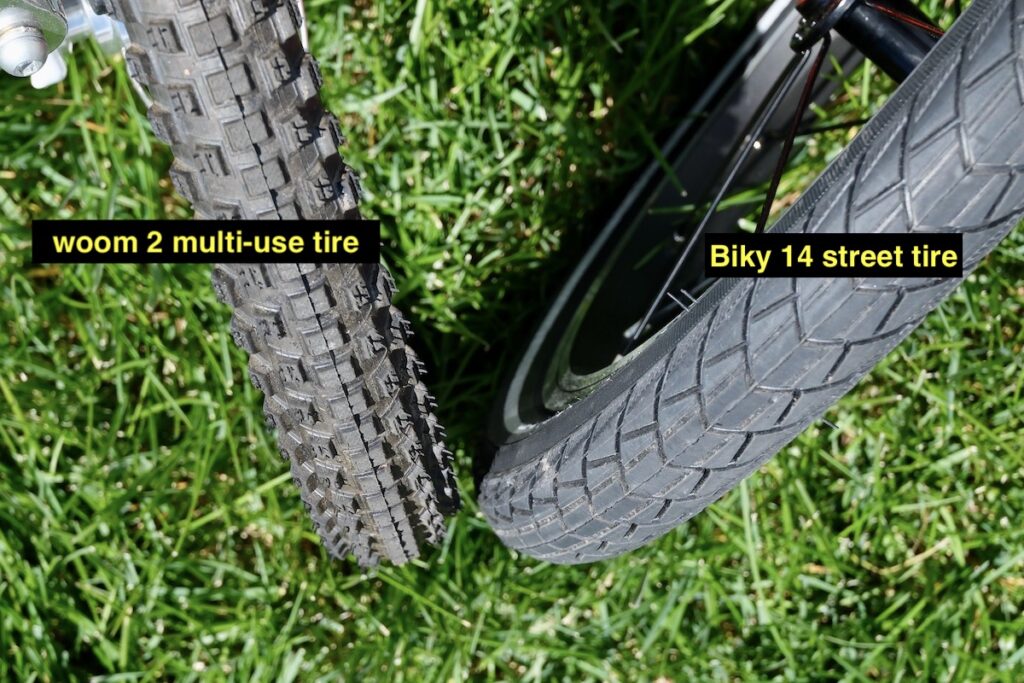
While Guardian also features smooth street tires, woom and Prevelo offer multi-use tires.
Biky Air vs. Competitors Comparison Chart
Because of the ease of pedaling due to the longer crank arms, and the additional room for growth due to its longer wheelbase, the Biky is our favorite 14″ bike.
If you are on a budget though, the Guardian 14 is our best budget pick. If you prefer to stick to a tried and true brand, you can’t go wrong with a woom, but be sure to order the freewheel kit!
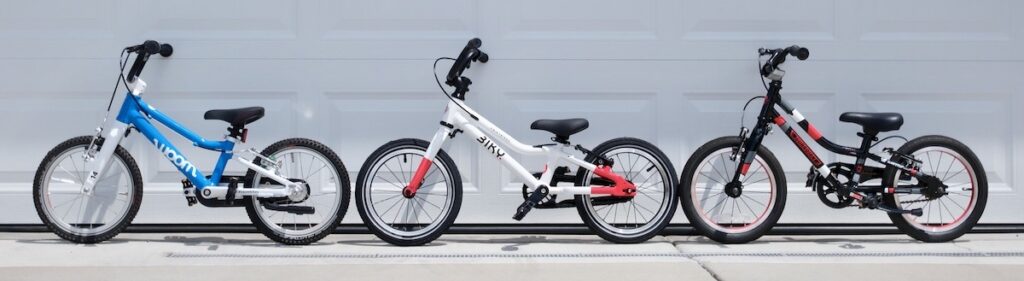
| woom GO 2 | Biky Air | Guardian | |
|---|---|---|---|
| MSRP | $439 + $19* | $399 | $249 |
| Long Wheelbase | ✔️ | ||
| Long Crank Arms | ✔️ | ||
| Under 13 lb. | ✔️ | ✔️ | |
| Dual Hand Brakes | ✔️ | ✔️ | ✔️ |
| No Coaster Brake | * | ✔️ | ✔️ |
| Seat Height | 16″ – 19.1″ | 17″ – 19”+ | 16″ – 20.8″ |
| Gain Ratio | 4.0 | 3.57 | 3.95 |
Biky Air 14 Bike Bottom Line
Not too big and not too small, the Biky 14 hits all the right features to make an exceptional 14″ bike. Easy to ride with plenty of room for growth, the Biky 14 allows your little one to easily transition to a pedal bike, without the concern of them outgrowing it too soon. As an added bonus, the longer crank arms of the Biky allow for a slower pedal speed, which makes learning to ride a bit easier for little ones.
FTC Disclosure: Affiliate links are included in this review. No monetary compensation was provided for this review, however, the reviewed product was supplied by the manufacturer or distributor to help facilitate this review. All opinions and images are that of Two Wheeling Tots LLC. All content and images are copyrighted and should not be used or replicated in any way. View our Terms of Use.